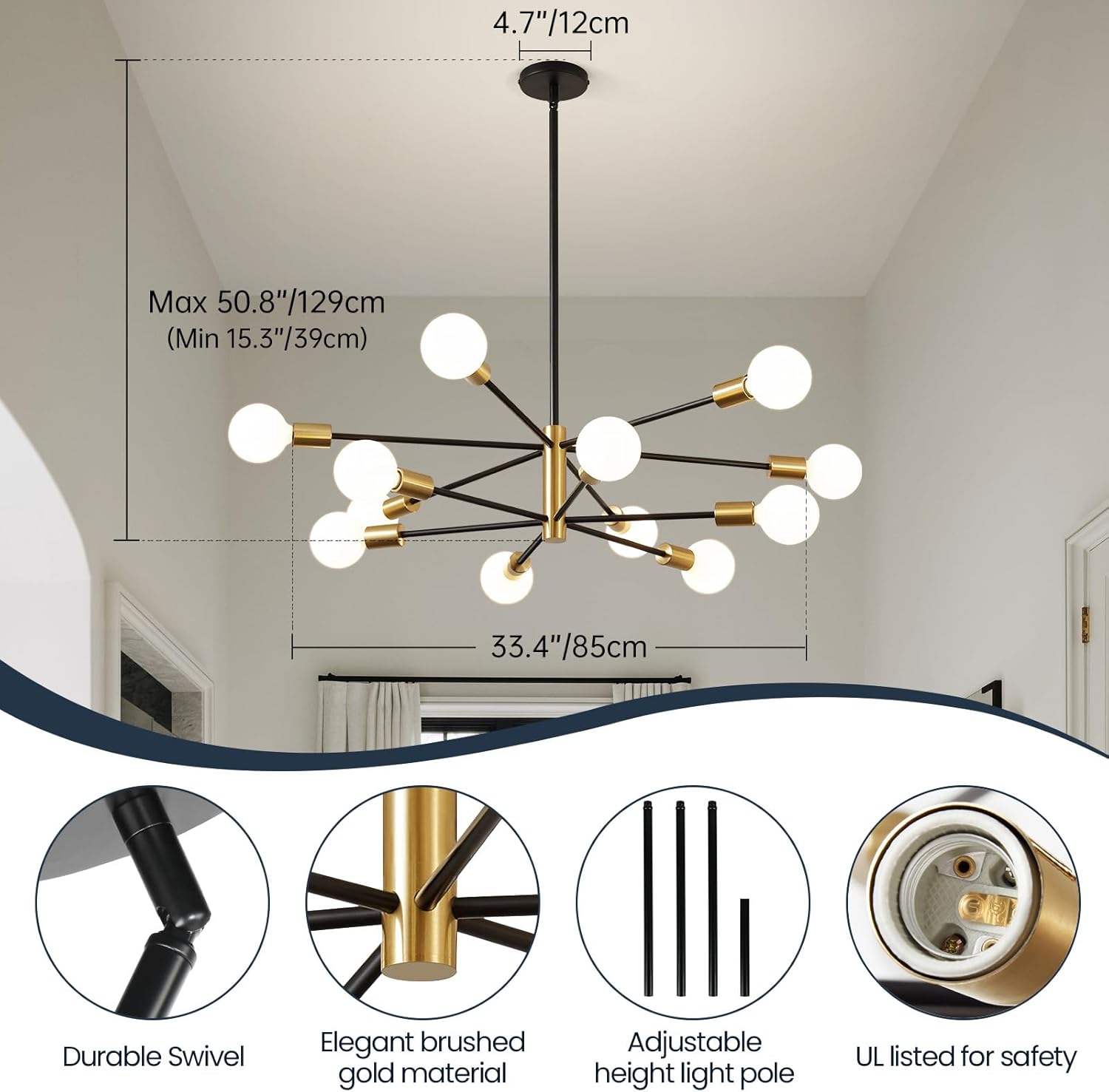
A Sputnik chandelier — named after the Soviet satellite launched in 1957, with its radiating arms and globe bulbs shooting outward from a central sphere — is one of the few lighting fixtures that functions as full-blown sculpture. At the right scale, in the right room, it stops visitors mid-sentence. At the wrong scale, it just looks like someone bolted a bike wheel to the ceiling. If you’re currently staring at a room and wondering whether a Sputnik is the move, this guide will walk you through the three decisions that actually determine success: sizing, finish selection, and room compatibility. No guesswork — just a clear framework you can apply to a space you’re working with right now.
What Makes a Sputnik Work (and What Makes It Fail)
The Sputnik’s defining visual logic is radial symmetry and visual weight from below. Unlike a drum pendant, which reads as a flat disc from across the room, a Sputnik reads the same from every angle — which is why it performs so well in spaces where sightlines vary (open-plan layouts, double-height foyers, dining rooms visible from adjacent living areas).
But that three-dimensional presence is also the trap. Architectural Digest’s mid-century modern design guide notes that multi-arm chandeliers require a meaningful vertical clearance to let the arms “breathe” visually — when a Sputnik hangs too close to the ceiling, the arms above the center sphere compress against the plane and the whole fixture looks like it’s being suffocated. When it hangs too low, you lose the satellite silhouette and start blocking sightlines across the room.
The two failure modes to avoid:
- Undersizing — A 12-inch Sputnik in a 14 × 16 ft dining room reads as an afterthought. The arms need enough span to register from a seated position across the table.
- Wrong arm count for ceiling height — A 24-arm, 36-inch fixture in a room with 8-foot ceilings creates visual chaos because there’s no negative space around the arms. The fixture needs room to be “read.”
Sizing Rules That Actually Prevent Returns
This is where most buyers go wrong, and it’s entirely preventable with two simple calculations. Per This Old House’s chandelier sizing guidelines, the standard formula for chandelier diameter in a dining room is:
Add the room’s length and width in feet → that number in inches = appropriate chandelier diameter
So a 12 × 14 ft dining room calls for a fixture roughly 26 inches in diameter. For a round or square room, the same rule applies — a 12 × 12 space targets a 24-inch fixture.
For foyers and entryways, Apartment Therapy’s sizing guide adds a ceiling-height modifier: in spaces taller than 10 feet, you can push 20–30% larger than the formula suggests because vertical volume creates proportional headroom for a larger fixture.
Sputnik-specific modifier: Because a Sputnik’s arm span is visually open (you see through it, unlike a solid drum shade), you can typically size up 10–15% from the formula without the fixture feeling overwhelming. The visual mass is lower than an equivalent-diameter solid fixture.
By the Numbers
| Room Type | Ceiling Height | Recommended Sputnik Diameter |
|---|---|---|
| Dining room (12×14 ft) | 9 ft | 24–28 in |
| Dining room (14×16 ft) | 9 ft | 28–34 in |
| Foyer / entryway | 10–12 ft | 30–42 in |
| Living room (open plan) | 10+ ft | 36–48 in |
| Bedroom (primary suite) | 9 ft | 18–24 in |
Hanging height: The bottom of the fixture should clear a dining table by at least 30–34 inches. In a non-dining context, the lowest arm tip should be at least 7 feet from the finished floor. In double-height spaces, hang so the fixture’s center sphere sits roughly at two-thirds the ceiling height — this anchors it visually without making it feel like it’s floating away.
Finish Selection: The Compatibility Decisions That Matter
Finish on a Sputnik isn’t just aesthetics — it’s the primary signal the fixture sends about the decade and register of the room. Get this wrong and the fixture fights everything else in the space.
Brass (aged, antique, or satin): This is the historically accurate finish for mid-century originals and it’s the one Houzz’s style guides consistently identify as the most versatile for transitional and mid-century spaces. Aged brass reads warm and slightly patinated — it pairs with wood tones (walnut, teak, white oak), warm whites, terracotta, and olive. If your hardware, plumbing fixtures, and furniture pulls are already trending warm-metal, aged brass Sputniks are the reliable choice. Elle Decor’s mid-century modern lighting coverage in 2024–2025 noted that unlacquered and aged brass Sputniks had strong staying power even as brushed nickel cycled back into kitchen cabinetry hardware.
Matte black: Strong contrast finish. Works when the room already has black anchors — window frames, cabinet hardware, chair legs. The risk: in a room that’s trying to be airy (white walls, light wood, linen), a matte black Sputnik can feel like a visual period at the end of a sentence that didn’t need one. Best suited to moody dining rooms, home offices, and rooms with significant dark contrast already present.
Chrome / polished nickel: The coolest (color-temperature) of the finishes. Chrome Sputniks read as more space-age and less “mid-century warm” — they’re at home in contemporary kitchens with stainless appliances and white cabinetry, or in a loft aesthetic. The tradeoff: polished chrome shows fingerprints on installation and the cool tone can make a warm room feel clinical. Satin or brushed nickel is a softer compromise.
Gold (bright/polished): Distinct from aged brass — bright gold is more Hollywood Regency than Eames-era. It can work in maximalist dining rooms or a powder bath as a deliberate glam statement, but it doesn’t read as “mid-century authentic” to most design-literate buyers.
The finish-compatibility checklist (run this before you buy):
- What finish is on my door hardware? (Should complement, not clash.)
- What finish is on plumbing fixtures in adjacent or visible bathrooms?
- Do I have warm-metal or cool-metal in my furniture frames?
- Is my room running warm (wood, cream, terracotta) or cool (white, gray, blue, black)?
If warm → aged brass or satin gold. If cool → brushed nickel, chrome, or matte black. If mixed → matte black is the safest neutral.
The Rooms Where Sputniks Actually Perform
Not every room is a Sputnik room. Here’s the honest breakdown.
Dining rooms: Yes, with conditions. This is the Sputnik’s natural habitat. The fixture hangs centered over the table, the radial arms read from seated sightlines, and the sculptural form earns attention during meals without competing with anything else. The condition: your ceiling needs to be at least 9 feet to avoid the “compressed arms” problem. In an 8-foot-ceiling dining room, size down aggressively (18–22 inches max) or consider a flush-mount Sputnik variant.
Foyers and entryways: Strong yes. A Sputnik in a foyer with ceiling height of 10+ feet is a design signature — it announces the home’s aesthetic immediately and works all 360 degrees because foyer sightlines vary as you enter, ascend stairs, and look back from upper floors. Architectural Digest’s mid-century coverage repeatedly uses foyers as the canonical Sputnik placement for this reason.
Living rooms: Conditional. In an open-plan space where the living room is clearly defined and has 10+ foot ceilings, a large Sputnik (36–48 inches) can anchor the seating area the way a statement rug does on the floor. In a standard closed living room with 9-foot ceilings, the math gets tight — a fixture large enough to register proportionally starts to crowd the visual field. In this case, consider a Sputnik-style semi-flush or a smaller 5–7 arm variant rather than a full multi-arm burst.
Bedrooms: Proceed carefully. A Sputnik in a bedroom is a bold move and it can land beautifully in a large primary suite with 10+ foot ceilings and a design-forward aesthetic. The risk: exposed bulbs (most Sputniks use exposed globe bulbs) create glare when you’re lying down looking up. If you’re going Sputnik in a bedroom, either choose a fixture with shielded bulb tips, install on a dimmer (mandatory, not optional), or position it off-center so the bulb array isn’t directly over the pillow line.
Kitchens: Rarely. Sputniks over kitchen islands are a design-blog move that rarely survives the practicality test. The arms collect grease and dust at extraordinary rates, and the open bulbs over food prep spaces create glare on countertops. If you want a mid-century fixture over a kitchen island, a pendant cluster or a linear globe pendant is a more functional choice.
Budget Tiers and What the Money Buys
The Sputnik market runs from roughly $80 to $2,000+, and the differences are meaningful — not just cosmetic.
Entry tier ($80–$200): Typically stamped steel arms, E12 candelabra bulb sockets, and paint finishes that may not hold long-term. Owners across aggregated reviews consistently report that entry-tier Sputniks from mass-market sources have arm wobble issues (the arms sit in friction-fit sockets rather than welded joints) and finishes that brass-tone unevenly within 18 months. Fine for a rental or a staging flip — not for a permanent installation.
Mid-range ($200–$600): Cast metal construction with set-screw or welded arm attachment, consistent finish application, and E26 standard-socket bulbs (meaning you have full bulb compatibility and can use smart bulbs for dimming). This is the sweet spot for most buyers. Brands at this tier — including options carried by Lumens and Capitol Lighting — offer meaningful finish quality and structural stability without the premium markup.
Premium ($600–$2,000+): Designer-house Sputniks from Visual Comfort, Arteriors, and Mitzi (Hudson Valley Lighting’s design line) come with UL listing, heavier gauge metal, consistent hand-applied finishes, and in some cases adjustable arm geometry. If finish compatibility is a genuine obsession (you’re specifying against unlacquered brass plumbing and aged brass cabinet hardware simultaneously), this tier is where the color-matching precision earns its cost.
The Decision Rule
If your room has 9+ foot ceilings and you’re working in a dining room, foyer, or defined living space: size up to the formula ceiling, choose the finish that matches your warmth/cool register, and go for it. A Sputnik is one of the few fixtures where bolder sizing almost always outperforms conservative sizing.
If your ceilings are 8 feet, you’re in a kitchen, or you’re prioritizing task lighting over sculpture: look at other fixture categories first — the Sputnik will frustrate you more than it rewards you.
If you’re between two sizes: go larger. Houzz community data and designer commentary consistently confirm that oversized chandeliers read as intentional; undersized ones read as a mistake.