You’ve decided to go smart with your lighting — meaning bulbs or fixtures that connect to your home’s Wi-Fi or a dedicated wireless hub, respond to your voice, your phone, or a schedule, and can shift color or brightness on demand. The question isn’t whether to do it anymore. It’s which platform to bet on. Lock into the wrong ecosystem and you’re either stuck with a patchwork of apps that don’t talk to each other, or you’re throwing away $200 in bulbs when you switch. Lock into the right one and your whole home’s lighting works like a single, well-designed instrument. This guide breaks down the four platforms that dominate the mid-2026 market — Philips Hue, Govee, Kasa, and the newer Matter standard — with explicit tradeoffs, real numbers, and a clear decision rule at the end.
What You’re Actually Choosing Between
Before you compare specs, it helps to understand what each platform is.
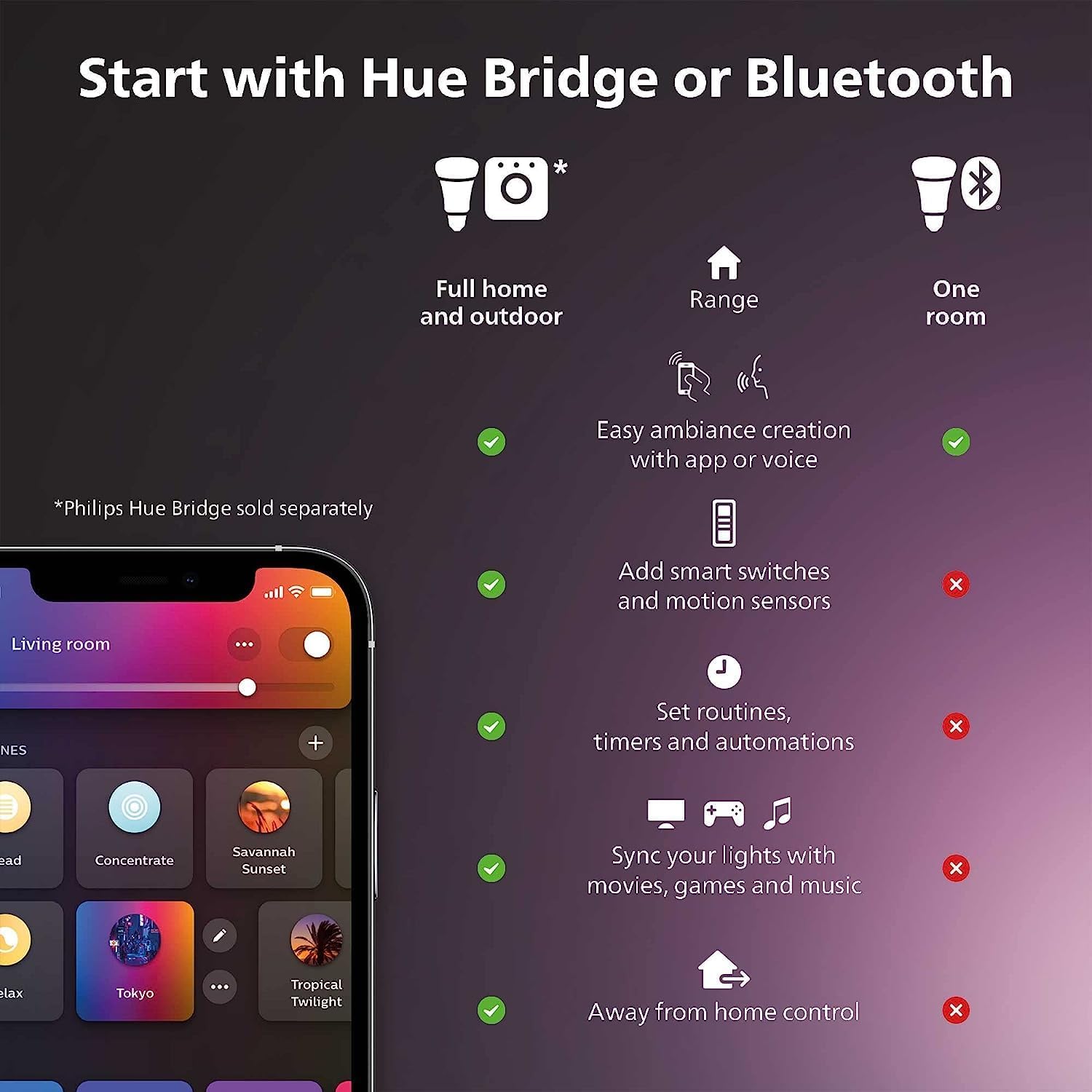
Philips Hue is the long-established premium ecosystem. It uses a dedicated Zigbee bridge — a small hub you plug into your router — and communicates independently of your Wi-Fi congestion. It integrates with every major voice assistant and smart home platform. The price point is real: a four-pack of Hue White and Color Ambiance A19 bulbs runs roughly $130–$160 at retail in mid-2026.
Govee is primarily known for LED strip lights and ambient accent products, but has expanded into smart bulbs and light bars. It runs on Wi-Fi or Bluetooth, requires no hub, and costs significantly less — often $15–$30 per bulb. Architectural Digest, in their 2025 roundup “The Best Smart Lighting Systems for Every Budget,” describes Govee as a strong choice for accent and mood lighting, with caveats about its closed ecosystem.
Kasa (by TP-Link) is a Wi-Fi-native smart home brand. Kasa smart bulbs connect directly to your 2.4 GHz Wi-Fi network without any hub. They’re reliable, well-reviewed, and typically priced at $10–$20 per bulb. Wirecutter’s guide “The Best Smart Light Bulbs,” published by The New York Times in 2025, consistently flags Kasa as the best-value pick for straightforward white-tunable lighting.
Matter is not a brand — it’s a standard. Think of it as a universal language that smart home devices can speak, developed by the Connectivity Standards Alliance (a consortium including Apple, Google, Amazon, and Samsung). A Matter-certified bulb or fixture is, in theory, compatible with any Matter-certified hub: Apple Home, Google Home, Amazon Alexa, or SmartThings. Apartment Therapy’s 2024 piece “Is Matter the Future of Smart Home Devices?” describes the standard as the industry’s most serious attempt at ending the fragmentation problem that has plagued smart home buyers for a decade — though adoption has been uneven.
The Four Ecosystems, Head-to-Head
Philips Hue: The Benchmark, With a Real Price Tag
Philips Hue has earned its reputation through reliability and depth. The Zigbee mesh protocol means your bulbs communicate with each other and through the bridge, not through your router — so a congested home Wi-Fi network doesn’t make your lights flicker or drop offline. Owners consistently report fewer connectivity issues compared to Wi-Fi-native systems, particularly in homes with 30 or more connected devices.
The color rendering is genuinely exceptional. Hue’s White and Color Ambiance line is spec-rated at CRI 80+, and the color spectrum covers roughly 16 million colors with smooth dimming down to about 1% brightness — a spec sheet detail that matters practically when you’re tuning a dining room for a dinner party versus a morning routine. Consumer Reports, in their 2025 “Smart Home Devices Buying Guide,” identifies Hue as the top performer in reliability and ecosystem depth, particularly for multi-room setups.
The tradeoff: You’re paying for that reliability. The Hue Bridge is a roughly $60 investment before you buy a single bulb, and the bulbs themselves are two to three times the cost of Kasa or Govee equivalents. For a full three-room installation — living room, kitchen, bedroom — expect to invest $400–$600 at realistic scale. Hue also locks you into its app and ecosystem in meaningful ways. While it integrates with Apple HomeKit, Alexa, and Google Home, some advanced scene features such as Entertainment Areas for syncing with TV content are Hue-native only.
Philips
$69.99
In stock on Amazon
Check price on AmazonKasa: The Practical Workhorse
Kasa hits a specific brief exceptionally well: reliable, affordable, tunable white-and-warm smart bulbs with no hub required. You add a Kasa A19 bulb, connect it to your 2.4 GHz Wi-Fi in two minutes, and it works. That’s genuinely the whole story for basic use cases.
Wirecutter’s “The Best Smart Light Bulbs,” published by The New York Times in 2025, specifically recommends Kasa for users who want schedule-based automation, simple dimming, and voice control without complexity. The Kasa app is clean and functional. Alexa and Google Home integration is native. Apple HomeKit compatibility exists on select Kasa products but has historically been inconsistent — something to verify per product SKU before buying if you’re in the Apple ecosystem.
The honest limitation: Kasa doesn’t prioritize full-spectrum color — smart color bulbs exist in the line but aren’t the core product strength. There’s also no mesh networking; each bulb independently connects to your router. In a large home or a Wi-Fi-challenged environment, that can mean occasional dropouts. Kasa also does not have Matter certification across its main bulb line as of mid-2026.
Best for: Anyone prioritizing value, simplicity, and basic white-light automation — especially first setups, rental properties, or secondary spaces where a $400 Hue investment isn’t justified.
 product image](/images/external/700b56351bce.jpg)
Kasa KL125P2
$14.99
In stock on Amazon
Check price on AmazonGovee: Accent-First, App-Dependent
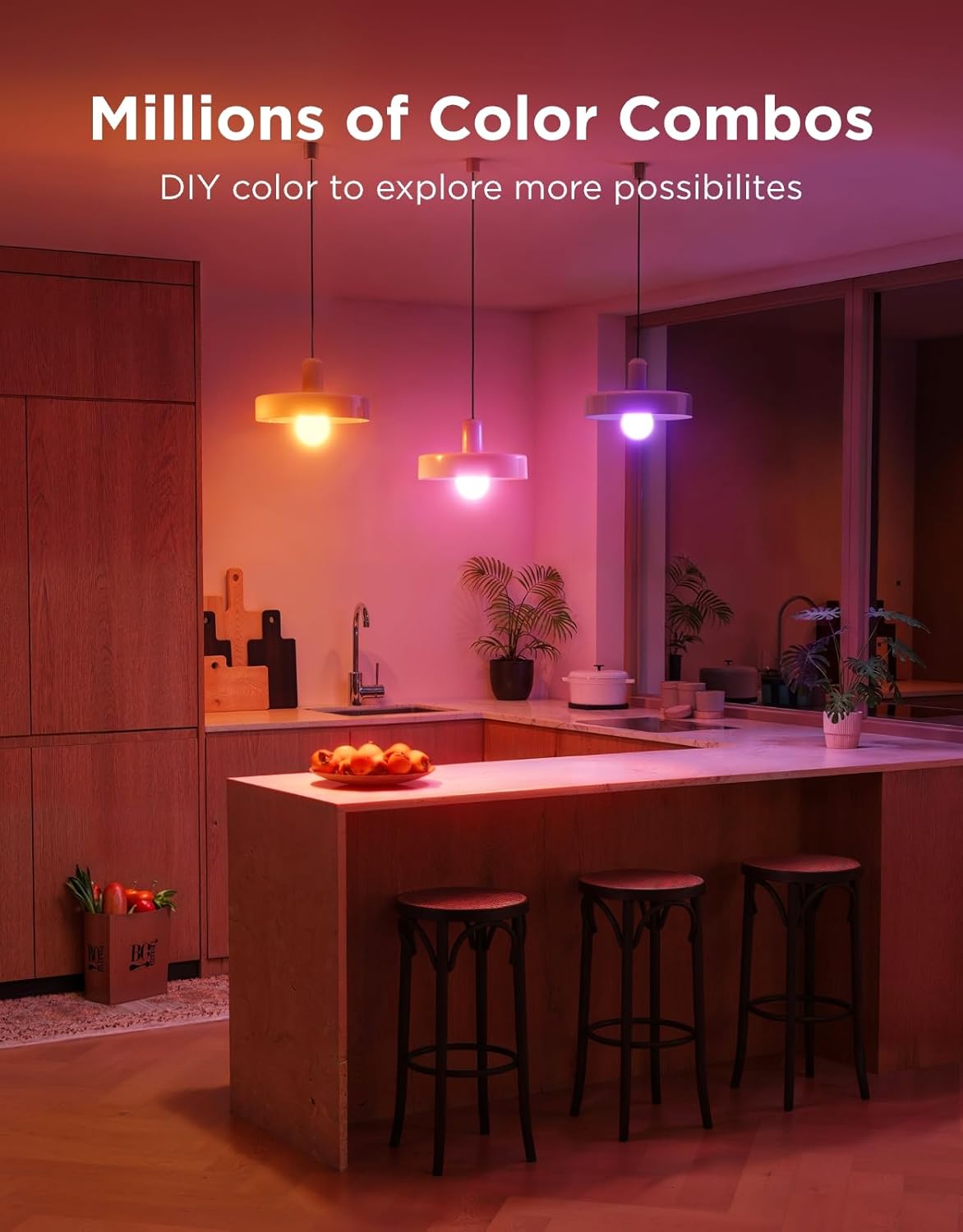
Govee’s sweet spot is ambient and accent lighting — the LED strip under a kitchen island, the bias lighting behind a monitor, the color-wash on a bookcase. Within that lane, owners and aggregated reviews consistently praise the app’s scene variety, the vibrant color saturation, and the low barrier to entry.
The limitations surface quickly when you try to use Govee as your primary lighting ecosystem. The platform runs on its own app and doesn’t natively integrate with Matter in a consistent, full-featured way — as of mid-2026, Govee’s Matter certification has been partial and inconsistent across product lines. This Old House’s 2025 “Best Smart Home Lighting Systems” roundup describes pairing Govee with Apple HomeKit or Google Home as functional but limited — you get basic on/off and brightness control, but not Govee’s full scene and music-sync features.
Govee’s Wi-Fi and Bluetooth dual-mode is genuinely useful: Bluetooth control works locally without internet, which matters if your router reboots or your ISP goes down.
Best for: Renters, apartment dwellers, or anyone building out accent and ambiance layers on top of an existing primary lighting setup — not as a whole-home replacement.
Kasa KL125P2
$14.99
In stock on Amazon
Check price on AmazonMatter: The Platform-Agnostic Long Game
Matter is the right answer to a specific problem: I don’t want to be locked in. If you’ve already invested in a smart home ecosystem — Apple HomeKit with a HomePod Mini as your hub, or Google Home — a Matter-certified bulb lets you add it to that ecosystem without a brand-specific app or bridge.
The practical reality in mid-2026 is more nuanced. Apartment Therapy’s 2024 assessment in “Is Matter the Future of Smart Home Devices?” notes that Matter adoption is real and growing, but the early product library was thinner than expected and the Thread protocol — the mesh networking layer Matter uses for reliability — requires a Thread border router. Your HomePod Mini, Apple TV 4K, Google Nest Hub Max, or Amazon Echo (4th generation) can serve this role, but it adds a prerequisite to the setup.
Matter-certified bulbs are now available from several manufacturers. The value is clearest for buyers already committed to one of the major smart home platforms who want future-proofed interoperability, not for buyers starting entirely from zero.
By the numbers (mid-2026 retail estimates):
- Philips Hue A19 color bulb (single): ~$40–$45
- Kasa smart tunable white A19: ~$10–$15
- Govee smart color A19: ~$15–$25
- Matter-certified bulb (from brands such as GE Cync or Sengled): ~$12–$20
Govee
$24.99
In stock on Amazon
Check price on AmazonThe Integration Question Everyone Skips
Here’s the decision layer most buyers underweight: What are you building this on top of?
If your home is Apple-forward — iPhone, HomePod, iPad as hub — HomeKit compatibility is non-negotiable for a seamless experience. Philips Hue and Matter-certified devices are your clean options. Kasa’s HomeKit support is inconsistent across SKUs. Govee’s is limited to basic functions.
If you’re Alexa-first, Kasa and Philips Hue both integrate cleanly. Govee works but with reduced feature access compared to its native app.
If you’re Google Home-first, Kasa, Govee, and Hue all have functional integrations; Matter adds another reliable path as the product library matures.
If you’re planning a Lutron Caséta or RadioRA system for your dimmers and switches, note that Philips Hue and Lutron have a documented direct integration — the two platforms can be paired through the Hue bridge to create layered, coordinated scenes. That matters if you’re combining smart switches with smart bulbs in the same rooms.
This Old House’s 2025 “Best Smart Home Lighting Systems” roundup reinforces the point: the integration question is often more consequential than the bulb spec question. Buying the highest-rated bulb that doesn’t mesh with your existing hub or voice assistant creates friction you’ll deal with every day. Architectural Digest’s 2025 “The Best Smart Lighting Systems for Every Budget” echoes this, advising readers to map their existing platform first and select bulbs second — not the other way around.
The Decision Frame
This is not a “best overall” question — it’s an “if X, then Y” question.
If you’re treating smart lighting as permanent home infrastructure and want the most reliable, deepest-featured system: Philips Hue. Accept the higher cost as infrastructure spend, not an impulse purchase. Consumer Reports’ 2025 “Smart Home Devices Buying Guide” supports this framing: Hue consistently ranks at the top for long-term reliability among tested systems.
If you need reliable, affordable white-light automation for two to six bulbs without a hub: Kasa. It’s the honest workhorse recommendation — and the one Wirecutter’s “The Best Smart Light Bulbs,” published by The New York Times in 2025, returns to for this use case.
If you’re layering accent and ambient effects on top of an existing system — strips, bias lights, color accents: Govee. Don’t rely on it as your primary overhead lighting platform, but within its lane it delivers strong color saturation and scene variety at a price point that’s hard to argue with.
If you’re already invested in Apple Home, Google Home, or Amazon Alexa and want future-proofed flexibility: Look for Matter-certified options first, then evaluate whether Hue’s premium depth justifies the added cost for your specific rooms. Apartment Therapy’s 2024 “Is Matter the Future of Smart Home Devices?” makes the case that Matter is the right long-term bet for platform-agnostic buyers — the caveat being that you need patience for the product library to fully mature.
If you’re a designer or integrator specifying for a client: Hue combined with Lutron Caséta remains the most defensible combination for layered lighting control at the $1,500–$3,000 project level. Matter’s interoperability promise is real but the premium fixture library isn’t fully there yet as of mid-2026.
The worst outcome isn’t picking the “wrong” ecosystem — it’s buying 15 bulbs from three different platforms and living inside three different apps with no coherent automation logic. Pick a lane. Build depth in it. Add a second platform only where it clearly fills a gap the first one can’t.
Sources referenced: Wirecutter, “The Best Smart Light Bulbs,” The New York Times, 2025; This Old House, “Best Smart Home Lighting Systems,” 2025; Apartment Therapy, “Is Matter the Future of Smart Home Devices?” 2024; Consumer Reports, “Smart Home Devices Buying Guide,” 2025; Architectural Digest, “The Best Smart Lighting Systems for Every Budget,” 2025.