A plug-in wall sconce is exactly what it sounds like: a wall-mounted light fixture that gets its power from a standard electrical outlet rather than from wires hidden inside your wall. That single distinction is the reason they’ve become a go-to move in bedrooms — you get the clean, elevated look of hardwired sconces without cutting drywall, hiring an electrician, or losing your security deposit. If you’ve been living with table lamps eating up nightstand real estate, a pair of plug-in sconces on the wall beside your bed is one of the highest-impact, lowest-commitment lighting upgrades you can make. This guide breaks down what to buy, why the cord situation is less awkward than you think, and how to pick the right brightness and arm style for how you actually use your bed.
Why Nightstand Space Is the Real Reason to Buy These
Reviewers across plug-in sconce categories keep naming the same trigger: they bought the sconce because their nightstand lamp was in the way. That’s not a minor convenience complaint — it’s a spatial planning issue. A standard table lamp with base and shade occupies roughly a 12–16 inch footprint on a surface that also needs to hold a phone, water glass, book, and anything else in the overnight rotation.
Apartment Therapy, in its ongoing small-bedroom upgrade coverage, consistently highlights wall-mounted lighting as the single change that makes a compact room feel intentional rather than cramped. When your light source moves to the wall, the nightstand becomes a functional surface again. That’s the actual job these fixtures are doing.
The secondary benefit — and reviewers mention this almost as often — is that the finished result reads as significantly more expensive than the price tag suggests. A fabric-shade sconce mounted at the right height, with the cord managed cleanly, looks like a designer detail. The gap between what it costs and what it communicates is unusually wide in this product category.
The Cord-Management Decision: Hidden, Visible, or Hybrid
Here’s the tradeoff most buyers underestimate before purchasing: the cord is real, it runs down the wall to an outlet, and what you do with it determines whether your sconce looks polished or provisional.
Your three options:
-
Cord cover (raceway): A paintable plastic channel that mounts flush to the wall and conceals the cord entirely. This Old House, in its guide “How to Mount a Wall Sconce Without Running New Wire,” recommends raceways as the standard solution for plug-in fixtures on flat drywall. When painted to match the wall, the result is nearly invisible and the sconce reads as hardwired to casual observers.
-
Fabric cord cover: A braided textile sleeve that slips over the existing cord. It doesn’t hide the cord — it styles it. This approach works well when your wall color is dark or when you’re leaning into an exposed-cord aesthetic (think vintage Edison fixtures or rattan shades). Several fabric-shade sconce buyers report intentionally leaving the wrapped cord visible as part of the look.
-
Run the cord behind furniture: If your headboard is tall enough, or if a dresser sits adjacent to your outlet, you can route the cord behind furniture so it disappears naturally. Zero cost, minimal effort — worth checking before you buy anything.
The math on cord length: Most plug-in sconces ship with 5–8 foot cords. If your wall outlet is at baseboard level and your sconce mounts at 60–65 inches (the standard eye-level height when sitting up in bed), you need at least 5–6 feet of cord accounting for the vertical drop plus any horizontal routing. Measure before you mount; an extension cord behind a raceway is a workable solution if needed, but it adds a step.
Swing-Arm vs. Fixed: A Decision Frame
This is the comparison that matters most functionally, and it breaks cleanly along use-case lines.
| Swing-Arm | Fixed/Hardback | |
|---|---|---|
| Best for | Active readers, two readers at different heights | Ambient mood lighting, symmetrical pairs |
| Adjustability | Arm pivots 90–180°; head often tilts | None — light direction is fixed at install |
| Built-in dimmer | Often yes (knob on arm or base) | Less common; smart bulb recommended |
| Cord visibility | Cord moves with arm — harder to conceal | Cord is static — easier to raceway |
| Visual weight | More mechanical, industrial | Cleaner, more minimal |
If X, then Y:
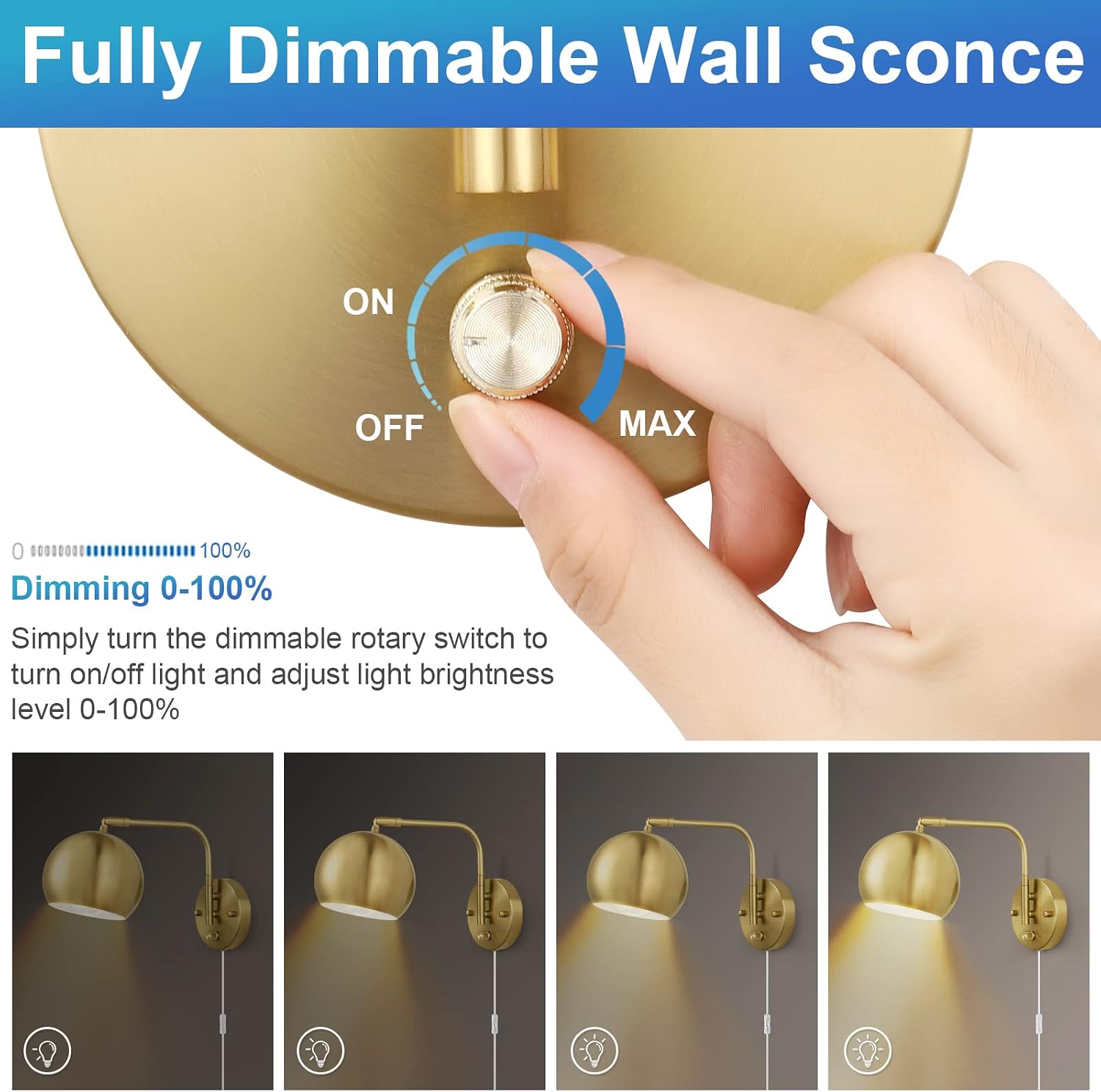
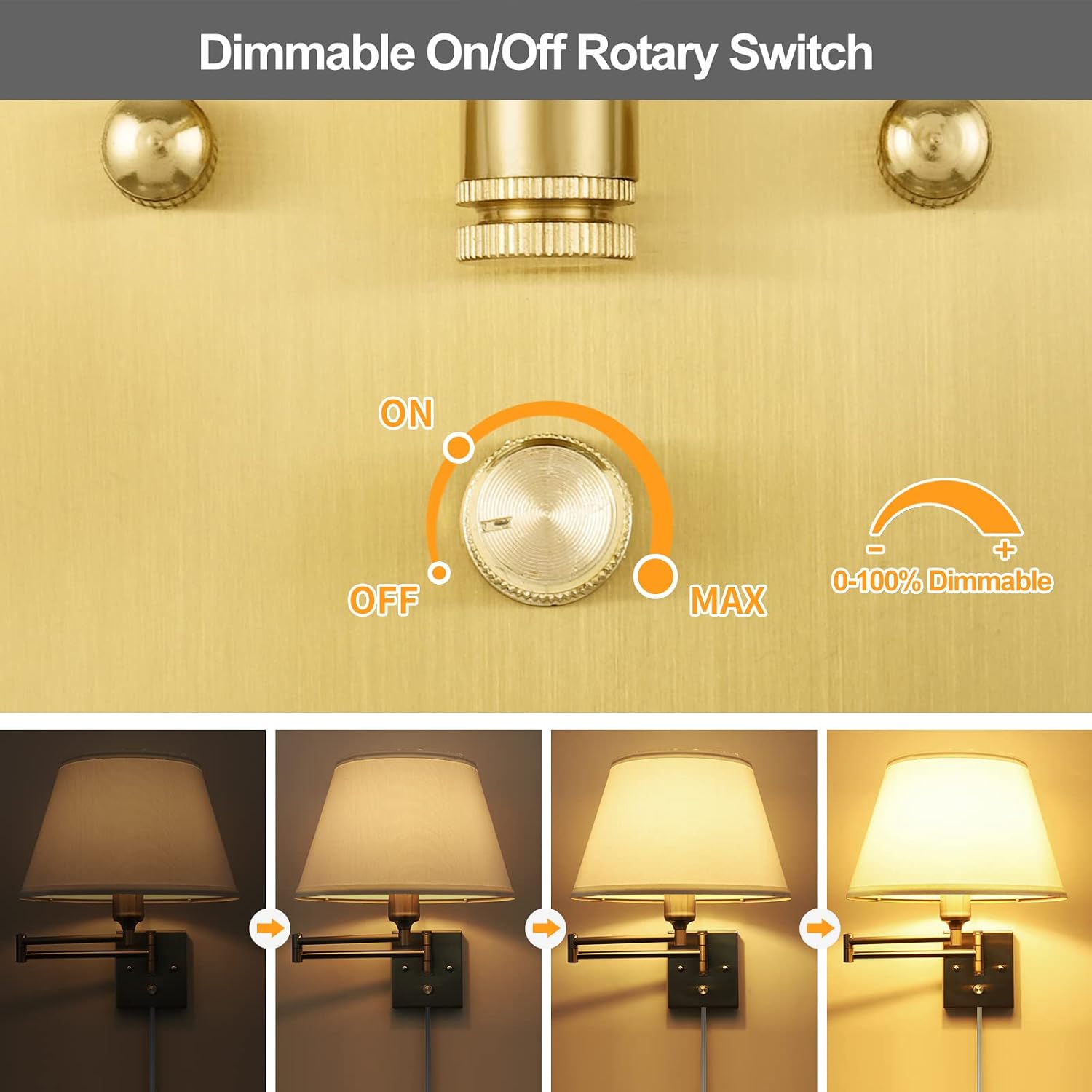
- If you read in bed regularly → swing-arm. Models with built-in dimmer knobs on the arm itself are the clearest examples of why: you get directional control and brightness control without needing a smart bulb or a wall switch. One knob does both jobs.
- If you want ambient light for a couple, symmetrical glow, or you’re pairing with a dimmable smart bulb → fixed shade. The fixed sconce’s cleaner silhouette photographs better and layers more easily into a styled room.
- If you’re in a rental and want maximum reversibility → fixed sconce with a cord cover. Fewer moving parts means less wall contact and a cleaner uninstall when you move.
Brightness, Bulb Type, and the Smart-Bulb Hybrid Approach
Most plug-in sconces ship without bulbs and accept E26 base bulbs — the standard medium-base size used in most American lamps, the same as a typical floor lamp bulb. For bedside reading, the sweet spot is 400–800 lumens (lumens measure total light output; higher numbers mean brighter light). For ambient mood use, 200–400 lumens is sufficient.
The built-in dimmer vs. smart bulb tradeoff:
Swing-arm models with built-in dimmer knobs give you analog brightness control at the fixture. No hub, no app, no compatibility research. Reviewers who buy these specifically call out eliminating the need for a smart bulb as a feature, not an afterthought.
Fixed sconces without a dimmer give you an on/off switch only. If you want app control or voice control (Amazon Alexa, Google Home), the workaround is straightforward: install a dimmable smart bulb. Architectural Digest, in its feature “How to Layer Bedroom Lighting Like a Designer,” notes that smart bulbs in fixed sconces are a designer-approved workaround when switching circuits isn’t an option. A clean hybrid approach pairs any fixed-shade sconce with a Philips Hue A19 or GE CYNC bulb for app-controlled dimming — a solution that costs less than replacing the fixture and works reliably.
One important note on globe sconces: Some matte black globe sconces generate confused negative reviews from buyers who don’t realize both cords are intentionally adjustable at the base — the cord length between the wall plate and the globe can be extended or shortened by pulling or feeding cord through the canopy. This is a design feature, not a defect. If your globes are hanging at uneven heights after mounting, adjust the cord at the base before concluding something is wrong with the fixture.
Beyond the Bedroom: Versatility Worth Knowing
Plug-in sconces get marketed almost exclusively as bedroom products, but the use cases are broader. Houzz community discussions on kitchen lighting show consistent interest in plug-in sconces over sinks — buyers citing proximity to an existing outlet and a fixture’s water-resistant ceramic base as reasons to install in a kitchen rather than a bedroom. Entryways, reading nooks, and home offices are other natural fits. If you’re specifying for a client, or staging a home that needs a quick lighting upgrade in multiple rooms, knowing that a single plug-in sconce model can solve problems across several spaces makes the per-unit cost easier to justify.
Mounting Two Sconces at the Same Height (Without a Second Person)
This is a real installation pain point that buyer reviews surface repeatedly. The standard approach requires marking the wall, drilling, and stepping back to check level — a process that’s genuinely hard to do accurately solo.
A reliable solo method:
- Measure up from the floor (not down from the ceiling — floors are more consistent than ceiling heights) to your target mount height on both sides of the bed.
- Mark both points with a small pencil mark, then use a laser level (a basic cross-line model costs under $25) to confirm both marks are at identical heights before drilling.
- Mount a strip of painter’s tape horizontally across both marks. Use the tape line as your drill guide.
The laser level step is the one most solo installers skip and then regret. This Old House’s installation guidance on paired wall fixtures identifies a laser level as the single tool that most reliably prevents asymmetric mounting when working alone.
Product Tiers to Consider
Plug-in sconces fall into three rough price-and-feature bands. Understanding what each tier does and doesn’t include helps you spend where it matters for your situation.
Budget-Friendly Fixed Sconces
Entry-level fixed sconces in the $25–$45 range typically offer a fabric or linen shade, a simple on/off rotary switch on the cord, and a standard E26 socket. They do the job well for ambient nightstand lighting and are easy to replace without regret. The tradeoff is cord quality — budget models often ship with thinner cords that benefit most from a fabric sleeve or raceway to look finished. Pair with a smart bulb if you want dimming capability.
VATONI
$59.99
In stock on Amazon
Check price on AmazonMid-Range Swing-Arm Sconces
The $50–$90 range is where built-in dimmer knobs, metal arm construction, and longer cords (often 7–8 feet) become standard. Swing-arm models in this tier are the workhorses of the category — they serve active readers reliably, hold their adjustable position without drooping over time, and eliminate the need for a smart bulb entirely. This is the tier that Apartment Therapy’s small-bedroom upgrade features most frequently reference as the practical sweet spot.
TRLIFE
$65.99
In stock on Amazon
Check price on AmazonPremium Hardwire-Ready and Designer-Adjacent Sconces
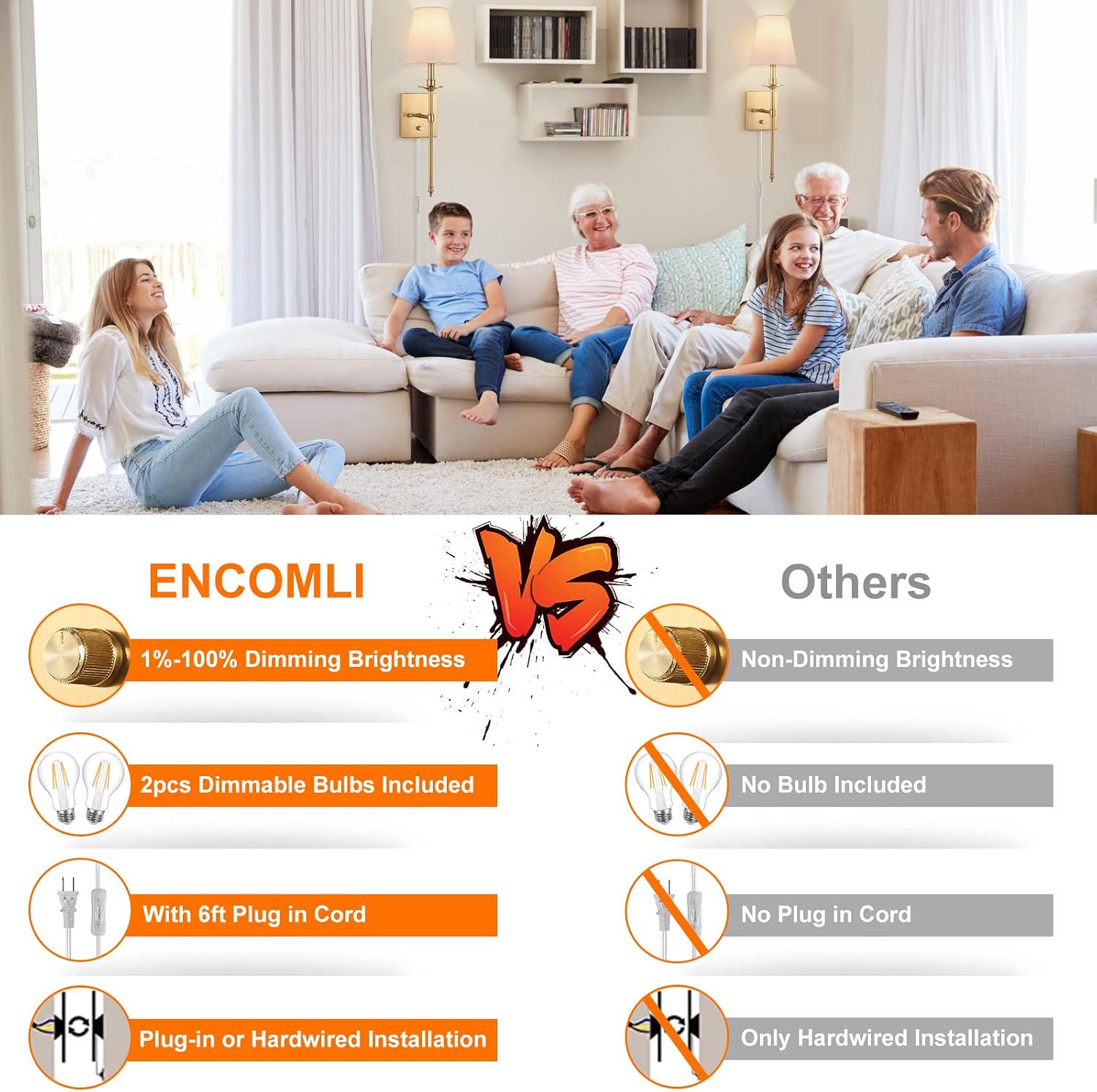
Above $90, plug-in sconces begin to include features like brass or matte black powder-coated metal construction, UL-listed hardwiring capability (so the fixture can be converted by an electrician during a future renovation), linen or seeded-glass shades, and cord colors that coordinate with the fixture finish. Architectural Digest’s bedroom lighting coverage consistently places these in the same visual register as hardwired designer fixtures. The cord still exists, but at this tier the fixture itself earns enough visual authority that a cleanly raceways cord reads as intentional.
Dimmable
$66.99
In stock on Amazon
Check price on AmazonFrequently Asked Questions
Can I hide the cord on a plug-in wall sconce so it looks hardwired? Yes — a paintable cord raceway (also called a cord cover or cable channel) mounts flat to the wall and conceals the cord completely. Painted to match your wall color, it’s nearly invisible. This Old House’s guidance on plug-in fixture installation identifies this as the standard approach for most drywall surfaces.
How long are the cords on most plug-in sconces — will they reach my outlet? Most models ship with 5–8 foot cords. Measure the vertical distance from your mount point to your outlet, add a foot or two for routing, and compare before you buy. If the cord falls short, an in-wall-rated extension cord routed inside a raceway is a clean solution.
Do plug-in wall sconces work with smart bulbs for app or voice control? Yes, if the fixture has a standard E26 socket and the switch stays in the on position. Install a compatible smart bulb (Philips Hue, GE CYNC, or similar) and control brightness and color temperature from your app or voice assistant. Sconces with built-in dimmer knobs require a smart bulb rated as compatible with leading-edge dimmers — check the bulb packaging before purchasing.
What’s the difference between a swing-arm sconce and a fixed sconce for bedside reading? A swing-arm extends from the wall on a pivoting arm so you can direct light exactly where you need it — ideal for reading. A fixed sconce is stationary; it casts light in one direction and works better for ambient or mood lighting than for focused task lighting.
Can I hardwire a plug-in sconce later if I renovate? Many plug-in sconces can be hardwired by removing the plug end of the cord and connecting directly to a junction box — but this varies by model, and the work requires a licensed electrician in most jurisdictions. Check whether your specific fixture is rated for hardwiring before planning around it.
How do I mount two sconces at exactly the same height without a second person? Measure up from the floor on both sides, mark both points, and use a cross-line laser level to confirm they’re level before drilling. A $20–$25 laser level makes this a reliable one-person job and is the tool This Old House’s paired-fixture installation guidance recommends above all others for solo installs.