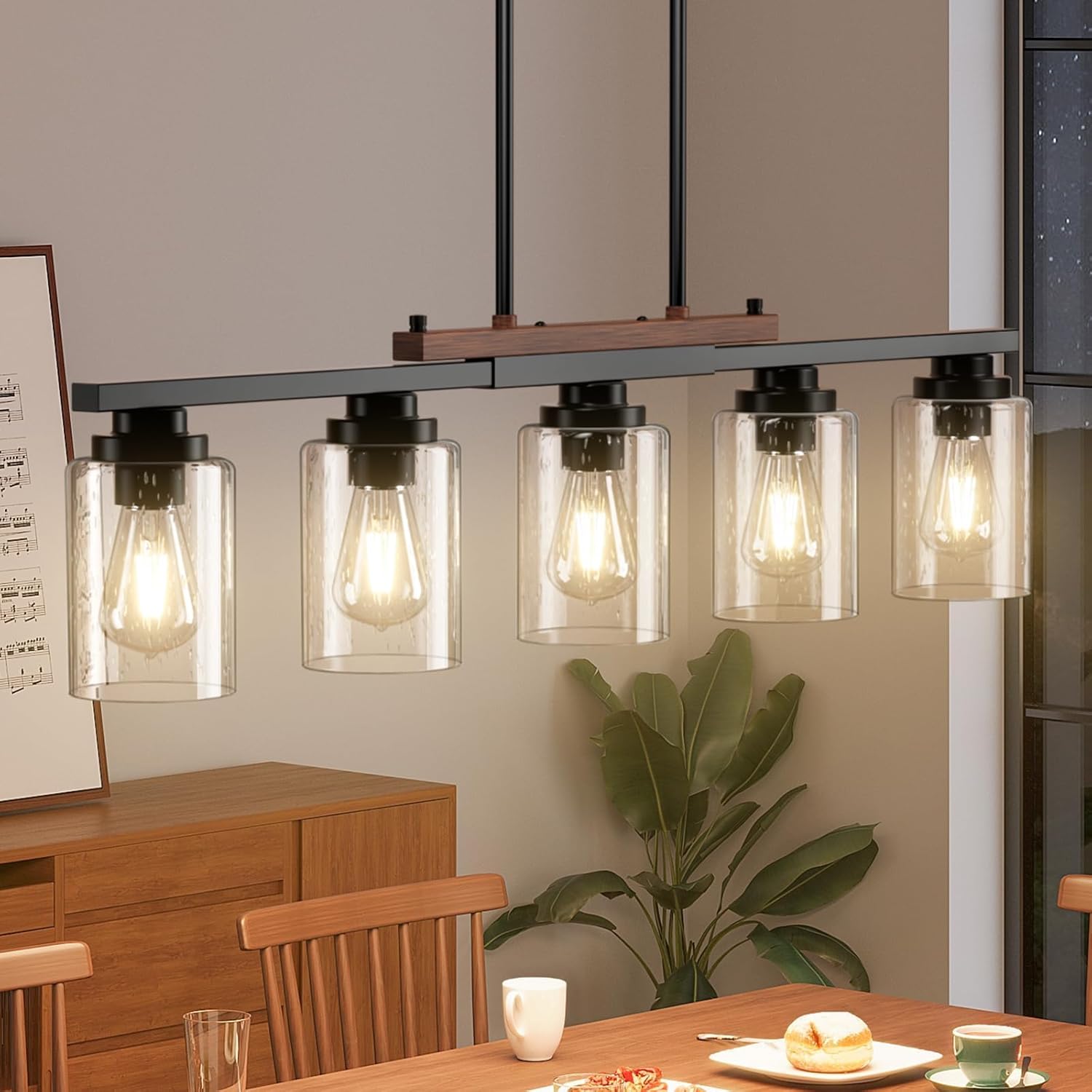
A chandelier is just a ceiling light with multiple arms or bulbs — but in a dining room, it’s also the first thing anyone looks at. Get it right and the whole room has a center of gravity. Get it wrong and you’ve got a fixture that looks like an afterthought, or worse, a prop from a Halloween store. The farmhouse chandelier category — think wrought-iron candle-style arms, shiplap-inspired wood accents, Edison-bulb clusters, and matte black or aged-bronze finishes — has exploded at the budget end of the market. You can find a five-light fixture for $59 or $149, and the price difference doesn’t always track the quality difference. This guide is about knowing which is which before you pull the trigger. You’ll come away with a clear decision framework: what details separate a fixture that reads “intentional design choice” from one that reads “it was on sale.”
| EDITOR'S PICK[Ganeed Rustic Chandeliers](https://www.amazon.com/dp/B0DSB6Y38V?tag=greenflower20-20) | Mid-tier[Qamra Modern Farmhouse Gold Cha…](https://www.amazon.com/dp/B09MCK85R9?tag=greenflower20-20) | Budget pick6-Light Farmhouse Candle Chande… | |
|---|---|---|---|
| Number of Lights | 8 | 8 | 6 |
| Material | Iron | — | — |
| Color/Finish | Bronze | Gold | Matte Black |
| Style | French Country | Modern Farmhouse | Rustic Industrial |
| Price | $99.92 | $89.92 | $69.99 |
| See on Amazon → | See on Amazon → | See on Amazon → |
Why Budget Farmhouse Chandeliers Fail (the Actual Reasons)
The category problem isn’t price — it’s manufacturing shortcuts that telegraph themselves the moment natural light hits the fixture. Here’s where the tells live.
Finish depth. A convincing aged-bronze or matte-black finish has slight tonal variation — highlights, shadowed recesses, a sense that the metal has a past. Budget fixtures often use a flat spray coat that looks fine in a product photo shot on a white background and looks institutional under your dining table. Houzz’s editorial coverage of farmhouse lighting specifically calls out “monotone spray finishes” as the single easiest way to date a budget fixture. The fix: look for product images that include close-ups of the metal, or filter reviews for any mention of the finish appearing “plasticky” or “flat.”
Canopy and mounting hardware. The canopy is the decorative plate that covers the ceiling junction box where the wire enters. On fixtures above $200, canopies tend to be solid metal with real weight. On sub-$100 fixtures, the canopy is often the thinnest stamped piece in the whole assembly — sometimes visibly seamed, sometimes hollow-sounding if tapped. Reviewers consistently single this out: a fixture that looks great at arm’s length reveals itself at the ceiling line. This matters especially in rooms with 9-foot ceilings where the canopy is at eye level for anyone standing.
Chain quality and length adjustability. Most farmhouse chandeliers ship with 60 inches of chain and instructions to loop excess links back up through the canopy. Cheap chain has visible seam lines at each link and flexes loosely. Better chain at any price point has tighter tolerances — links don’t rattle visually when you walk past. Check reviewer photos (not manufacturer photos) for how the chain photographs at distance.
Shade material and thickness. If the fixture uses fabric shades or wire cages, material weight is the tell. Thin fabric shades (often described as “linen-look” but made of polyester) show hot spots — bright patches around the bulb — instead of diffusing light evenly. Wire cage fixtures avoid this issue entirely, which is part of why they dominate the upper end of the budget category: there’s no fabric to cheap-out on.
The Sizing Rules That Apply Regardless of Budget
Before evaluating any specific fixture, nail the math. Architectural Digest’s chandelier sizing guide lays out the standard formula, which most designers use as a baseline: add the room’s length and width in feet, and that sum in inches is your target fixture diameter. A 10×12 dining room calls for a chandelier roughly 22 inches wide. For hanging height over a table, This Old House recommends the bottom of the fixture sit 30–36 inches above the tabletop — a rule that holds whether you’re spending $75 or $750.
By the numbers:
- Room 10 ft × 12 ft → target fixture diameter: ~22 in
- Standard dining table height: 30 in; hang fixture bottom 30–36 in above surface
- Ceiling-to-bottom clearance in 8-ft rooms: aim for at least 7 ft of headroom clearance
- Fixture weight above 35 lbs requires a rated ceiling brace, not just the junction box
Where budget buyers go wrong: they buy a fixture that photographs well at scale, then discover it’s 16 inches wide — undersized for anything beyond a breakfast nook. Always confirm the diameter listed in the spec sheet, and be aware that some listings measure “overall width” including bulbs or cage extensions rather than the central body.
What $75–$99 Gets You (and What It Doesn’t)
At this price point, the market is dominated by five-light candle-style chandeliers and simple cage pendants, primarily from Amazon’s house brands and imported lines. The wins are real: you can get a fixture with a decent matte-black finish, appropriately weighted arms, and proper candelabra sockets (which take E12 bulbs — the small-base type — and allow for slim Edison-filament bulbs that are the visual centerpiece of the farmhouse look).
The consistent losses at this tier:
- Canopy and chain (as discussed above) are where corners get cut
- Arm count vs. proportions — five-light fixtures at this price often have arms spaced too closely, creating a cluster that reads small even when the nominal diameter is adequate
- Wiring gauge — not a safety issue per se if the fixture is UL-listed (always confirm this), but thin wiring can be frustrating to work with during install
Apartment Therapy’s coverage of farmhouse lighting notes that the most reliable sub-$100 fixtures are ones with simpler geometry: a straight-arm or Y-arm configuration over ornate scrollwork, because there are fewer junctions where finish inconsistency shows.
If X, then Y at this tier: If you’re furnishing a rental, staging a home for sale, or outfitting a mudroom or breakfast nook where the fixture will be viewed in passing rather than as a focal point — the $75–$99 tier is defensible. Pair with quality Edison filament bulbs (the bulb does 40% of the visual work) and you’re fine.
What $100–$149 Gets You (and Why the Gap Matters)
This is where the category separates, and it’s worth understanding why. At $100–$149, you start to encounter:
- Heavier gauge metal in the arms and body — owners in aggregated reviews consistently note that fixtures in this range feel “substantial” rather than hollow
- Better canopy castings — thicker, occasionally brushed rather than spray-coated
- More finish options — aged brass and antique gold appear at this tier, not just matte black and bronze
- Wider diameter options — 24-inch and 26-inch fixtures become available, covering more dining room sizes
Elle Decor’s 2025 roundup of chandelier trends specifically highlighted the convergence of woven-shade farmhouse designs with transitional dining rooms — a look that largely lives in the $120–$200 range and is now accessible at the budget end because of supply chain maturation in Southeast Asian manufacturing.
The failure modes at $100–$149 are subtler: you may get better metal but thinner fabric shades, or a larger diameter fixture with arms that look proportionate in spec photos but reveal themselves as slightly too light-gauge for the span once installed. Reviewers in this tier frequently mention that the fixture “looks great” but that installation revealed alignment issues — arms not perfectly level, canopy plate not sitting flush. These are assembly-tolerance issues, not material failures, and they’re solvable with patience during install.
The honest comparison: A $149 farmhouse chandelier from a mid-tier lighting brand will not be mistaken for a $400 Visual Comfort fixture by anyone who looks closely. But it can absolutely hold its own in a dining room with good lighting design around it — appropriate bulb warmth (2700K is the sweet spot for farmhouse warmth, per the U.S. Department of Energy’s residential lighting guidance), a dimmer switch (any fixture with standard E26 or E12 sockets is dimmer-compatible with a compatible dimmer, though always verify bulb-dimmer pairing), and deliberate layering with sconces or undercabinet light in adjacent spaces.
The Specific Details to Vet Before You Buy
Here’s the decision checklist that separates a considered purchase from a return:
- UL listing: Non-negotiable. If the product listing doesn’t explicitly state UL or ETL listing, pass.
- Fixture diameter vs. room formula: Run the math above. Don’t approximate.
- Finish close-ups: Scroll past the hero image. Find reviewer photos taken in real rooms under real light.
- Canopy description: Look for “solid metal canopy” or a weight spec. A fixture listing “included mounting hardware” without canopy description is a yellow flag.
- Chain adjustability: Confirm the chain length and whether you can add or remove links. Some budget fixtures use fixed-length rods rather than chain — verify your ceiling height before ordering.
- Bulb type and count: E12 candelabra sockets limit you to lower-wattage bulbs; E26 standard sockets give you more flexibility. For Edison filament bulbs — the look that makes farmhouse chandeliers sing — both socket types work, but confirm maximum wattage ratings.
- Return window: Given the difficulty of assessing finish quality from photos, buy from a retailer with a 30-day return window. Many Amazon sellers offer this; some budget lighting sites do not.
If X, Then Y — The Decision Rules
If your room is under 10×10 and your ceiling is 8 feet: Stay at 18–20 inches diameter, prioritize a fixture with chain (not rod) for height adjustability, and don’t agonize over price tier — a $75 fixture done right beats a $149 fixture that’s too large.
If your dining room is 10×12 or larger: Budget for the $100–$149 tier specifically to get a 22-inch+ diameter without compromising arm weight. A visually undersized chandelier is the most common regret in this category, per Houzz community feedback on lighting updates.
If you’re staging a home: Go cage-style, no fabric shades — cage fixtures photograph better, age better (no shade yellowing), and read as intentional in listing photos. The $85–$110 range has strong options here.
If this is a long-term home you care about: Spend the $149 and put the remaining money into quality 2700K dimmable Edison bulbs and a $40 dimmer switch. The bulb-and-dimmer upgrade does more for the atmosphere than the fixture price difference alone.
If you’re torn between two fixtures at the same price: Choose the one with fewer ornate details. Simple geometry ages better, photographs better, and hides finish inconsistency better. The farmhouse aesthetic is fundamentally about restraint — a clean five-arm candle chandelier in matte black will outlast a scrollwork-heavy fixture stylistically, regardless of which one cost more.
The sub-$150 farmhouse chandelier market has genuinely matured. The gap between what $149 buys today versus five years ago is real, documented in aggregated buyer reviews and visible in the expanding finish options now available at price points that used to deliver only flat black. The work is in knowing what to look for — and now you do.