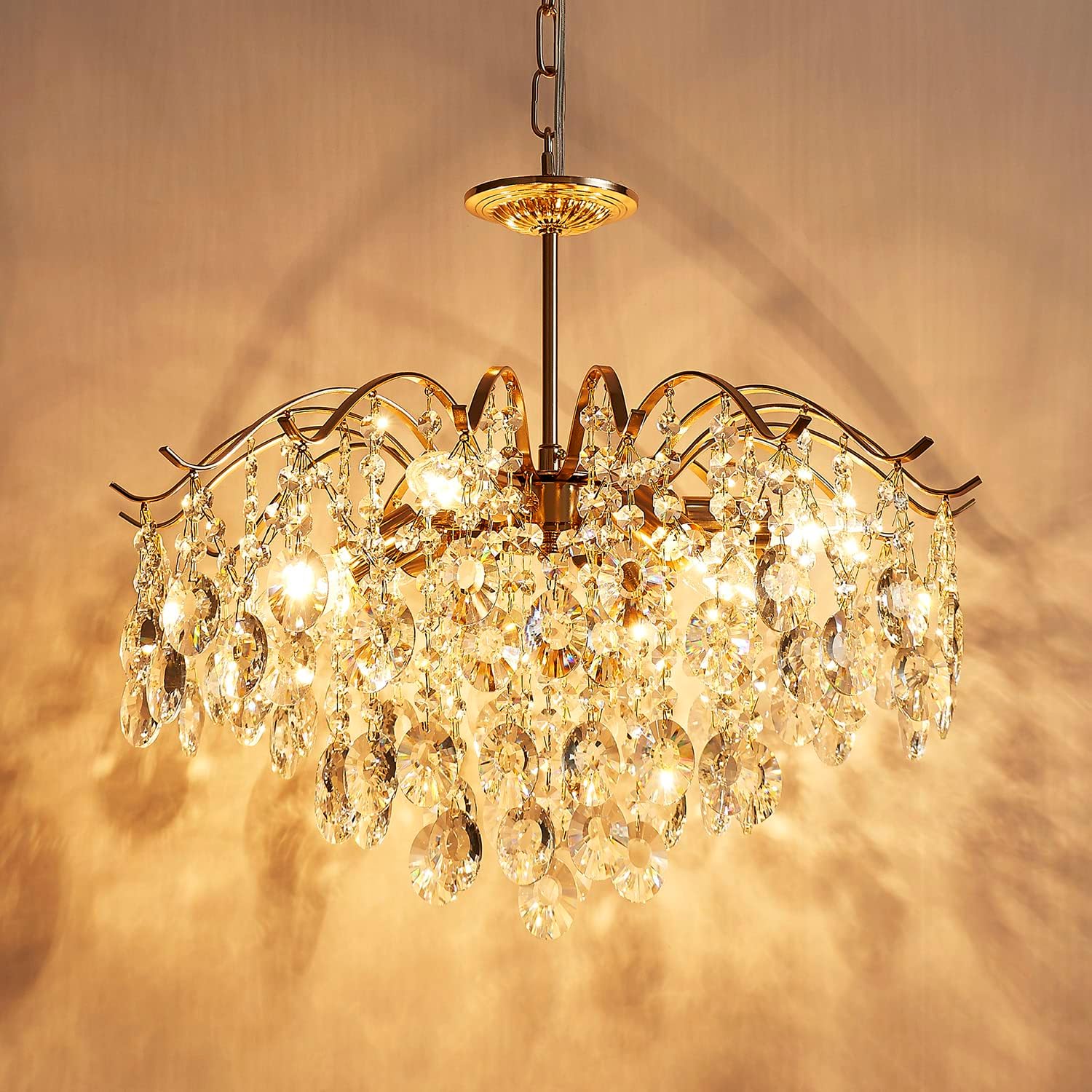
A crystal chandelier is, at its simplest, a light fixture — usually suspended from the ceiling — that uses transparent or faceted decorative elements (the “crystals”) to catch, scatter, and multiply light across a room. When it works, it’s one of the fastest ways to signal that a space has been designed with intention. When it doesn’t work, you end up with a fixture that looks like it came in a box from a gas station gift shop and photographs grey under every lighting condition. The difference between those two outcomes almost never comes down to price alone. It comes down to a handful of material and construction decisions that most product listings bury in the fine print — or skip entirely. This guide walks you through exactly those specs, in plain language, so you can make the call before the fixture ships.
| EDITOR'S PICK[Siljoy Rectangle Gold Crystal C…](https://www.amazon.com/dp/B0BZJ42JMH?tag=greenflower20-20) | Mid-tier[CM MZY 12-Light Crystal Firewor…](https://www.amazon.com/dp/B09G3HPQNN?tag=greenflower20-20) | Budget pick[Saint Mossi 5 Light Modern Cont…](https://www.amazon.com/dp/B09F37RZL3?tag=greenflower20-20) | |
|---|---|---|---|
| Number of Lights | 16 | 12 | 5 |
| Crystal Type | K9 Crystal | — | K9 Crystal |
| Dimmable | ✓ | — | — |
| Height Adjustable | ✓ | — | — |
| Shape | Rectangle | — | — |
| Finish | Gold | Gold | Clear |
| Price | $431.99 | $135.98 | $89.99 |
| See on Amazon → | See on Amazon → | See on Amazon → |
The Crystal Question: Glass, Acrylic, and the K9 Middle Ground
The single most important variable in a crystal chandelier is what the “crystals” are actually made of. This isn’t snobbery — it’s physics. The ability of a material to bend and separate light (measured as its refractive index) is what creates that signature sparkle and rainbow scatter. Higher refractive index equals more visual drama per lumen.
Here’s how the main options stack up:
Full lead crystal (Swarovski Strass, Asfour, Riedel): The traditional benchmark. Lead oxide added to glass raises the refractive index to roughly 1.70, producing the deepest prismatic throw. Swarovski Strass — the Austrian brand’s architectural-grade product line, used in fixtures by Visual Comfort, Schonbek, and Waterford — is precision-cut and polished to tolerances that create consistent facets. Asfour, an Egyptian manufacturer, is widely specified in mid-to-high-end fixtures and produces comparable refraction at a somewhat lower price point. These materials are heavy, which affects both shipping cost and mounting requirements. Architectural Digest’s chandelier selection guide specifically names crystal grade as a primary quality differentiator, noting that Strass and Asfour are the reference standards for residential specification work.
K9 glass crystal: This is where most of the market — and most of the confusion — lives. K9 is a designation for a borosilicate-adjacent optical glass originally developed in China that produces a refractive index around 1.52, meaningfully lower than lead crystal but still capable of attractive light scatter when precision-cut. This is the material you’ll find in fixtures from $80 through $600+. The designation tells you the base material; it tells you almost nothing about cut quality or polishing. A well-cut K9 pendant can look terrific. Poorly cut K9 looks cloudy and flat, especially in photographs.
Acrylic (plastic): Refractive index around 1.49. Not inherently bad for all applications — a playroom fixture or a rental property where durability matters is a legitimate use case — but it reads as plastic under most lighting conditions, especially in photos. Apartment Therapy’s feature on budget fixture upgrades makes the point plainly: acrylic crystals lose the prismatic effect almost entirely because the facets aren’t sharp enough to separate light properly.
The decision rule: If the listing says “crystal” without specifying the type, assume K9 at best, acrylic at worst. If you’re spending more than $300 and the listing still won’t tell you, that’s a yellow flag.
Cut, Clarity, and the Factory Variables Most Buyers Miss
Knowing the base material gets you halfway there. The other half is execution — how the crystals are cut, polished, and strung.
Facet precision: Crystal elements are either machine-cut or hand-finished. The sharpness of each facet edge determines how cleanly the fixture separates white light into color spectrum. In published spec sheets and owner reviews, the language to look for is “precision-cut” or “hand-polished” in the element description — not just in the marketing copy for the fixture overall. Across aggregated reviews on Houzz for chandeliers in the $400–$1,200 range, the pattern is clear: buyers who report disappointment almost always mention that the crystals look “dull” or “hazy” in person, which typically traces back to fire-polished (heat-smoothed rather than mechanically cut) or low-tolerance machine-cut elements.
Clarity and inclusions: Like gemstones, glass crystals vary in how many internal bubbles or impurities they contain. You won’t get a clarity grade on a chandelier spec sheet, but you can proxy for it: fixtures using named-brand crystal (Strass, Asfour, Preciosa) have quality-controlled sourcing that eliminates most inclusion problems. Generic K9 sourcing does not.
Stringing and hardware: This is where budget fixtures reveal themselves fastest in person. The wires or pins connecting crystal drops to the frame should be stainless steel or brass — not bare aluminum or plastic monofilament. Plastic eventually yellows and becomes brittle. Cheap metal wire corrodes and leaves rust streaks on the crystals below it. This Old House’s chandelier guide notes that hardware finish quality — including the stringing components you rarely see in product photos — is one of the most reliable indicators of overall fixture longevity.
Frame finish and construction: The metal frame (usually steel or zinc alloy) carries the crystal array and anchors to your ceiling. Electroplated finishes — chrome, aged brass, polished nickel — are standard at most price points. The difference between a $200 frame and a $900 frame in the same finish is typically coating thickness and base metal quality. Thicker plating resists corrosion longer and holds its color. Zinc alloy (sometimes called “zamak”) is cheaper than brass and more prone to finish degradation over time, especially in humid rooms like bathrooms. Elle Decor’s chandelier roundup consistently distinguishes between fixtures with solid-brass frames and those using plated zinc, flagging this as the primary durability variable in fixtures under $500.
By the Numbers: What the Specs Actually Mean
| Spec | Budget tier (<$200) | Mid tier ($300–$700) | Premium tier ($800+) |
|---|---|---|---|
| Crystal material | Acrylic or unlabeled K9 | Labeled K9 or mixed glass | Swarovski Strass, Asfour, Preciosa |
| Refractive index | ~1.49 | ~1.52 | 1.68–1.72 |
| Frame base metal | Zinc alloy (zamak) | Steel or plated zinc | Solid brass or cast iron |
| Stringing hardware | Plastic or bare wire | Coated steel wire | Stainless steel pins or brass wire |
| Cut method | Fire-polished | Machine-cut | Precision machine + hand-polish |
These numbers won’t appear on most product pages, but they’re the underlying reality behind what you’re buying.
Sizing and Placement: Where Most Installations Go Wrong
Even a technically excellent fixture reads as cheap if it’s scaled incorrectly for the space. This is the mistake This Old House’s chandelier guide calls the most common error in residential lighting — and it’s fully preventable.
Diameter for rooms: The standard rule of thumb is to add your room’s length and width in feet, then convert to inches. A 12-by-14 room → 26-inch diameter fixture. This is a starting point, not a hard ceiling. In rooms with 10-foot or higher ceilings, you can go larger. In rooms where the chandelier will compete visually with furniture (a dining table, a kitchen island), the fixture’s diameter should be 12 inches narrower than the table’s width to avoid an overwhelming look.
Ceiling clearance: For dining rooms and entry foyers, the bottom of the fixture should hang roughly 30–36 inches above the table or floor surface. In rooms where people will walk beneath the fixture (entry halls, living rooms), the lowest point should be at least 7 feet from the floor. These aren’t aesthetic preferences — they’re safety clearances that affect both code compliance and livability.
Canopy and mounting: The canopy is the ceiling-mounted plate that covers the electrical box and supports the fixture’s weight. Standard electrical boxes are rated for 35–50 lbs. Many larger crystal chandeliers exceed this. If your fixture weighs more than 35 lbs, you need a fan-rated or chandelier-rated brace box — this is non-negotiable and frequently overlooked in both budget and mid-tier installations. Houzz’s crystal chandelier style guide flags this as the most common installation oversight that leads to liability issues and fixture damage.
Finish Compatibility: The Detail That Makes or Breaks the Room
A crystal chandelier doesn’t live in isolation. It interacts visually with every other metal finish in the space — hardware, plumbing fixtures, cabinet pulls, mirror frames. Finish compatibility is the discipline of making those relationships intentional rather than accidental.
The current standard, well-established by 2026, is to work within a two-finish rule: one primary (dominant), one accent. Crystal chandeliers in polished nickel pair naturally with other cool-toned metals (brushed nickel, chrome). Aged brass chandeliers want warm companions — unlacquered brass hardware, oil-rubbed bronze, dark iron. Matte black is the most flexible neutral but clashes with highly polished chrome.
Where buyers make mistakes: they choose the chandelier finish based on the fixture photo alone, then discover it fights with the cabinet pulls they already installed. The fix is to identify your dominant finish first and treat the chandelier as a component in that system, not the anchor that everything else should adapt to.
The “If X, Then Y” Decision Framework
You’ve done the reading. Here’s the clean decision tree:
If you’re under $300 and need something that photographs well: Prioritize labeled K9 crystal (not “crystal-like” or “acrylic”) and a steel frame in a single solid finish. Spend your budget on crystal quality, not fixture size. A smaller, better-cut fixture outperforms a larger cheap one in every lighting condition.
If you’re in the $400–$800 range: This is where cut quality pays the biggest dividend. Look for fixtures that specify machine-cut or precision-cut elements, confirm the frame is solid brass or heavy steel plating, and verify that stringing hardware is stainless or brass wire. At this tier, named crystal brands (Asfour especially) are available and worth seeking out.
If you’re above $800: You’re now in Schonbek, Visual Comfort, and Arteriors territory. Swarovski Strass specification is common and worth confirming. At this level, the frame finish, proportions, and chain/stem adjustability are the primary differentiators — the crystal quality is assumed. Focus on sizing accuracy and finish system compatibility.
If the listing doesn’t name the crystal material: Ask before you order. Any reputable seller or manufacturer should be able to answer this in one email. If they can’t, the crystal is almost certainly acrylic.
The chandelier that actually looks expensive isn’t always the most expensive one. It’s the one where every spec — material, cut, hardware, finish, and scale — was chosen on purpose. That’s a research problem before it’s a budget problem, and now you have the research.