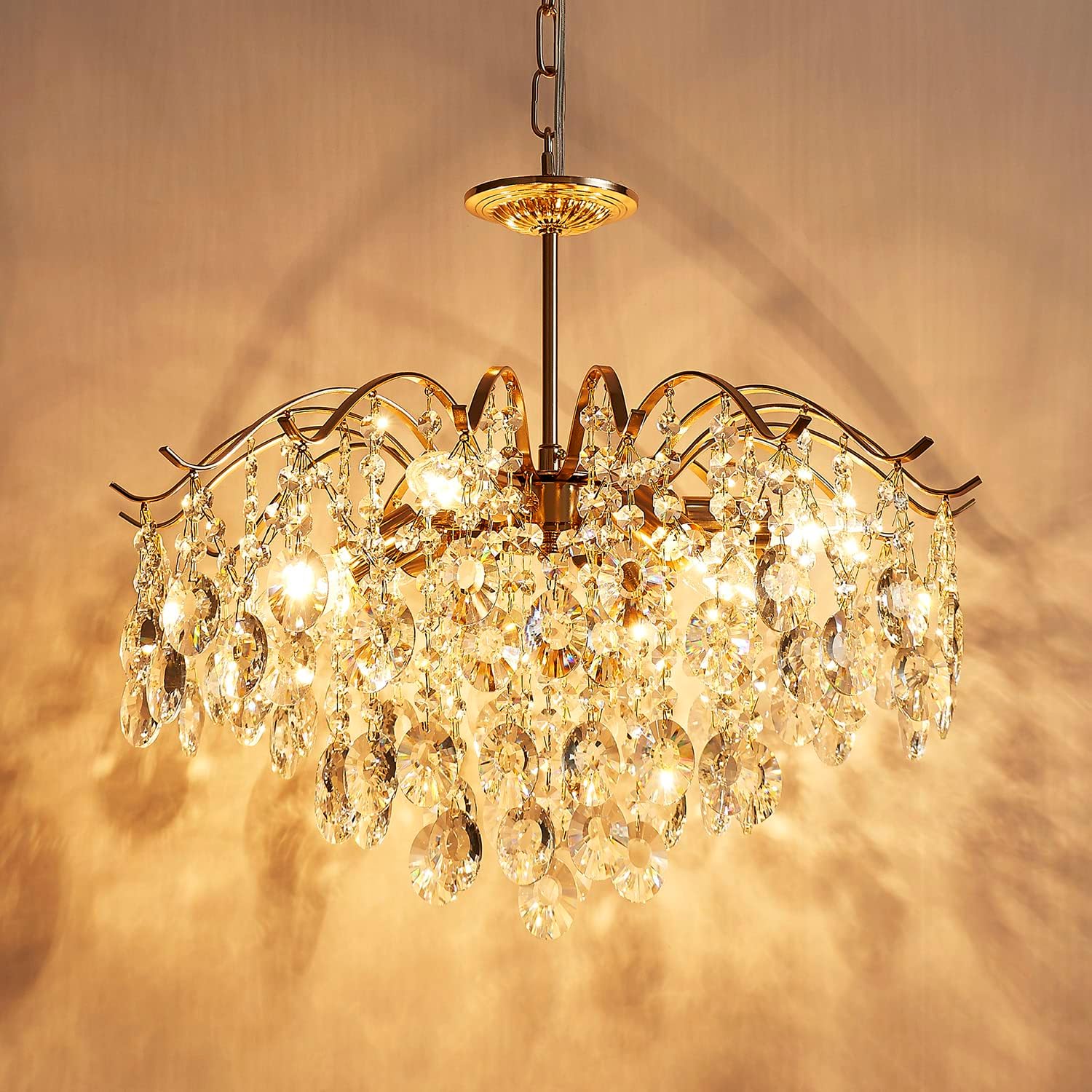
The Crystal Chandelier Assembly Deep-Dive: What Reviewers Actually Timed, Counted, and Regretted
You found a crystal chandelier that looks extraordinary in the listing photos. The price is right. You click buy. What nobody tells you — not the listing, not the spec sheet, not the glamorous room photos — is that between “box arrives at door” and “chandelier glowing above the dining table” sits a genuinely laborious middle chapter involving hundreds of individual crystals, small wire hooks, and at least one person in your household audibly questioning their life choices.
This article is a straight account of what real owners tracked during crystal chandelier assembly: how long it actually takes, what goes wrong, when it’s worth hiring help, and how to protect yourself from the single most avoidable mistake (discovering damage mid-install rather than at unboxing). If you’re at the “I just ordered this” or “deciding between models” stage, the data here will recalibrate your timeline and your confidence — in the right direction.
The Real Time Investment: What Reviewers Actually Counted
Let’s anchor on concrete owner data, because the range is wide enough to matter for your planning.
Across aggregated reviews on Houzz’s crystal chandelier community threads and retailer review sections, assembly time for a mid-size crystal chandelier — roughly 10 to 16 lights, 200 to 400 individual crystal drops — runs between 3 and 7 hours for a first-time installer working alone. That’s not hanging time. That’s just crystal-attachment time, on the floor or a table, before the fixture ever approaches the ceiling.
The Weesalife rectangular chandelier offers a particularly instructive data point: one owner counted approximately 200 crystals requiring individual hooks and documented the process in their review. Their verdict — “worth the effort, but patience is mandatory” — captures the consensus pretty well. Note the structure of that sentence: the reward acknowledgment comes after the honest warning. That’s the pattern across almost every detailed review in this category.
By the numbers — typical crystal chandelier assembly benchmarks:
| Fixture size | Crystal count (approx.) | Solo assembly time | Two-person assembly time |
|---|---|---|---|
| 6–8 light, small | 80–150 | 1.5–3 hrs | 1–2 hrs |
| 10–16 light, medium | 150–300 | 3–5 hrs | 2–3 hrs |
| 18+ light, large | 300–500+ | 5–8 hrs | 3–5 hrs |
These figures are drawn from aggregated reviewer accounts, not manufacturer estimates. Manufacturer estimates, when provided at all, tend to be optimistic by a factor of two.
The WUZUPS flower chandelier adds a different angle to the timeline question. One owner’s husband assembled it while — by her account — audibly complaining throughout. He then immediately requested a second one for another room once it was lit. That’s not a quirky anecdote; it’s a precise description of the effort-to-reward ratio that defines this category. The work is real. The result consistently exceeds expectations. Multiple reviewers across crystal chandelier lines use almost identical language: “pictures don’t do it justice,” “stunned by the beauty,” “the room is completely transformed.” The finished product routinely outperforms the listing photography — which, given how good listing photography has become, is a meaningful bar to clear.
The Pre-Assembly Inspection Rule (Learn It Before You Open the Hook Bags)
This is the decision that will either save you hours or cost you them.
The Saint Mossi 6-light gold chandelier produced a documented case study in what not to do: one owner discovered a damaged large crystal only after constructing an assembly scaffold and beginning installation. By that point, they were mid-hang, the fixture was partially assembled, and the damage — on one of the signature statement crystals — required stopping the entire project.
The fix here is simple and absolute: inspect every crystal before you attach the first hook.
This Old House’s chandelier installation guide recommends treating the unboxing as a formal quality check — not a casual look — precisely because fragile components shipped in segmented packaging rarely show damage until you’ve laid everything out flat. Here’s the inspection sequence that experienced owners describe:
- Lay all crystal components on a white sheet or towel. The contrast makes chips and cracks visible immediately.
- Check the large statement crystals first. These are both the hardest to replace and the most damage-prone during shipping, because carriers don’t treat them with the reverence their size deserves.
- Test every hook before hanging. Hooks that are bent or won’t close cleanly will cause crystals to drop — either during assembly or weeks later when vibration works them loose.
- Count against the parts list. Missing components are far easier to resolve before installation than after the fixture is wired and hanging.
The Ganeed rustic chandelier illustrates the upside of catching damage at unboxing: one owner documented a shipping damage case and received a free replacement within three days. That’s a good outcome — but it only works cleanly if you catch the problem before you’ve committed hours of assembly labor to the damaged fixture. File the claim immediately, document with photos, and don’t start attaching crystals until replacement parts are confirmed.
Spare Crystals, K9 vs. Acrylic, and the Quality Questions Worth Asking Now
Do crystal chandeliers come with spare crystals?
Occasionally, but not consistently, and the spares provided rarely match the most breakage-prone large drops. Across reviewer accounts, the pattern is that small accent crystals sometimes have a few extras included; the large statement pieces almost never do. If you’re ordering a fixture where the large drops are load-bearing visually — the kind that define the silhouette — ask the retailer about replacement crystal availability before you buy, not after one breaks.
How do you know if a chandelier uses real K9 crystal vs. acrylic or plastic?
K9 crystal (a specific optical glass formula developed in China that has become the standard for mid-range and upper-mid-range chandeliers) and quality acrylic can look nearly identical in listing photos. The practical tests owners cite most often:
- Weight: K9 crystal is noticeably heavier than acrylic of the same size. If a large drop feels lightweight, it’s probably not glass.
- Temperature: Glass feels cool to the touch at room temperature; acrylic is closer to ambient.
- Sound: Tap two crystals together gently — glass produces a clear ring; acrylic produces a dull click.
- Light dispersion: K9 crystal produces sharp, prismatic rainbow dispersion under direct light. Acrylic produces softer, more diffuse scatter. Neither is wrong aesthetically, but they read differently in the room.
Architectural Digest’s coverage of lighting material selection notes that K9 crystal’s optical clarity and refractive index sit meaningfully above standard glass, which is why it became the benchmark for mass-market crystal fixtures. If a listing doesn’t specify K9, that’s worth clarifying — not because acrylic is unusable, but because the two products have genuinely different visual outcomes at distance.
DIY vs. Hiring Help: The Honest Decision Frame
This is the question Apartment Therapy’s chandelier hanging guide addresses directly, and the answer has two parts that most framing collapses together: assembly and installation are different problems with different skill requirements.
Assembly — attaching crystals, connecting arm sections, building the frame — is almost always a viable DIY task. It’s time-consuming and detail-oriented, but it requires no specialized skills. What it does require: a clean flat surface, good lighting (ironic but true), patience, and ideally a second person for the larger fixture sections that become awkward to manage alone. Two people can cut assembly time nearly in half, and more importantly, a second set of hands prevents the specific frustration of a half-assembled section shifting and dumping previously attached crystals.
Electrical installation — wiring the fixture into the junction box, ensuring the ceiling medallion sits correctly, confirming the support bracket is rated for the fixture’s weight — is a different calculation. This Old House’s installation guide draws a clear line: if the fixture exceeds 35 pounds or if your junction box hasn’t been verified to handle chandelier loads, a licensed electrician or experienced handyman is not optional, it’s the right call. Crystal chandeliers in the 10–16 light range routinely hit 30–50 pounds fully assembled. A failure at the ceiling is not a cosmetic problem.
The decision rule:
- If you’re comfortable with basic electrical work and your ceiling support is confirmed: DIY both phases. Budget a full day, work with a partner on installation day, and don’t rush the crystal attachment.
- If your ceiling is high (12+ feet), the fixture is heavy, or you have any uncertainty about the junction box: DIY the assembly, hire for the hang. You’ll save several hundred dollars versus having a professional do everything, and you’ll eliminate the risk category that actually matters.
- If the timeline is tight (staging, event, renovation handoff): hire for both and treat the labor cost as insurance on a fixture you’ve invested real money in.
What Makes the Result Worth It (And Why the Effort Math Works Out)
The consistent pattern across owner reviews of crystal chandeliers at every price tier is a notable disconnect between the difficulty of assembly and the satisfaction with the result. Owners who document frustration during the process almost universally follow up with language about transformation — rooms that felt flat before reading as genuinely dramatic after, photographs that get stopped in their tracks by visitors, spaces that feel finished in a way that other fixture categories don’t deliver.
Houzz’s community threads on dining room lighting consistently rank crystal chandeliers as among the highest-rated purchases for perceived value versus cost — not because the assembly is easy, but because the result is visible from across the room, catches light throughout the day, and ages well. The sparkle-and-shadow play that K9 crystal produces at dinner is a category unto itself; no other fixture type replicates it at a comparable price.
The math, in plain terms: a well-chosen crystal chandelier bought in the $150–$600 range and assembled with appropriate patience delivers a visual result that competes with fixtures costing several times more. The assembly labor is the price of admission. It’s finite, it ends, and what remains is the fixture.
Frequently Asked Questions
How long does it realistically take to hang all the crystals on a 10–16 light crystal chandelier?
Plan for 3 to 5 hours of crystal-attachment work alone, working solo. With a partner sharing the task, that compresses to 2 to 3 hours. Add 1 to 2 hours for unboxing, inspection, and electrical installation. A full installation day is the realistic unit of time to block.
What should I inspect in the box before I start assembly to avoid discovering damage mid-install?
Lay every crystal component on a white surface before attaching a single hook. Check large statement crystals for chips and cracks first — these are the hardest to replace. Test every hook for clean closure. Count all pieces against the included parts list. Photograph any damage immediately and contact the retailer before starting assembly.
Do crystal chandeliers come with spare crystals, and are they the right size for the most breakage-prone pieces?
Sometimes, but rarely for the large drops most likely to break. Small accent crystals occasionally have extras; signature statement pieces almost never do. Confirm replacement crystal availability with the retailer at purchase if the large drops are visually critical.
Is it worth hiring an electrician or handyman to assemble and hang a crystal chandelier, or is it a genuine DIY job?
Crystal attachment is a reliable DIY task — time-consuming but skill-agnostic. Electrical installation is worth hiring out if the fixture exceeds 35 pounds, your ceiling is high, or your junction box support is unverified. Splitting the work (DIY assembly, hired installation) is a practical middle option that keeps costs manageable.
How do I know if a chandelier uses real K9 crystal vs. acrylic or plastic?
Glass K9 crystal feels heavier and cooler than acrylic, rings when tapped, and produces sharp prismatic light dispersion. Acrylic feels lighter and warmer, clicks when tapped, and diffuses light more softly. If the listing doesn’t specify K9, ask before buying — the two materials produce meaningfully different results in the room.