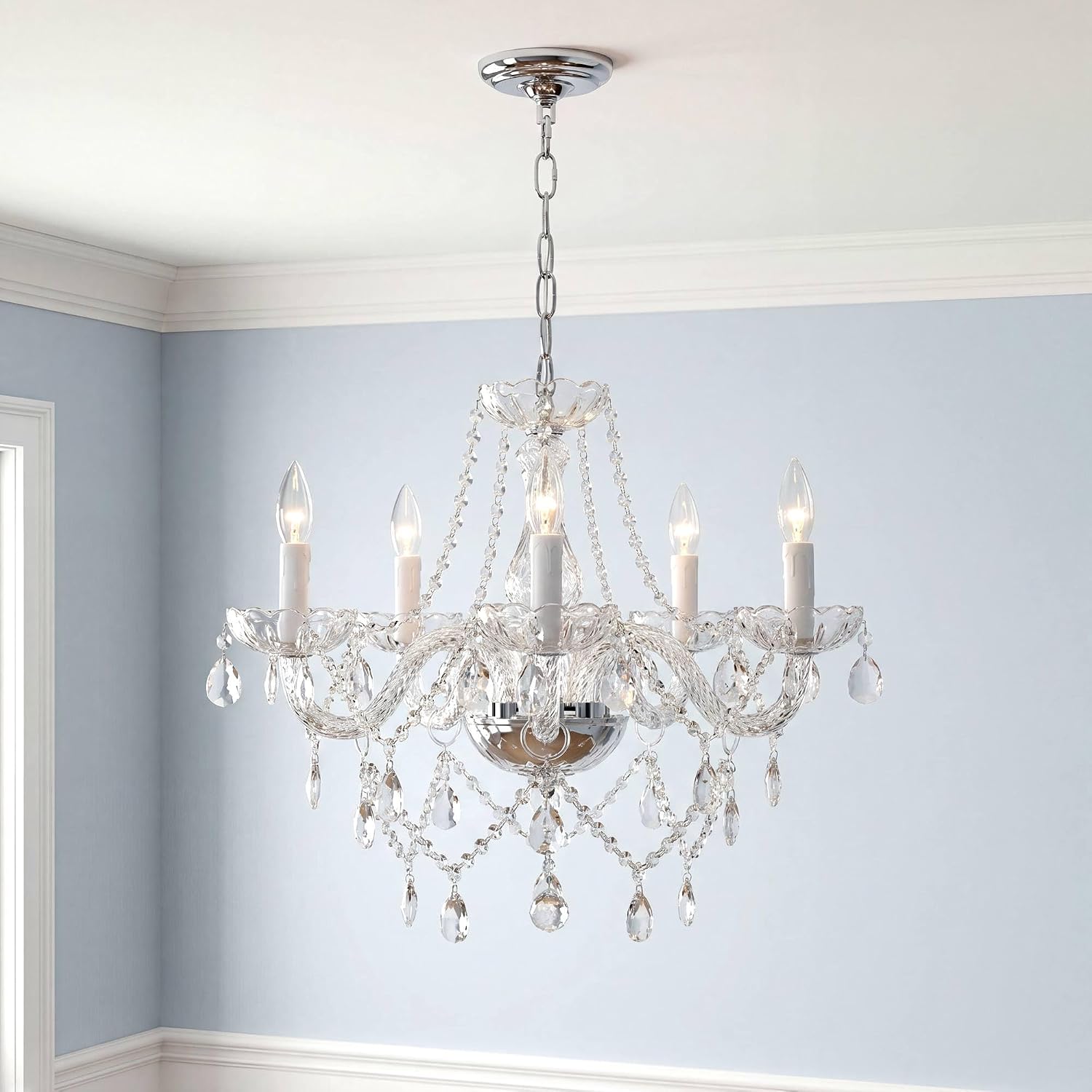
Crystal Chandelier Assembly Survival Guide: What Nobody Tells You Before You Buy
You ordered the chandelier. The box arrived. It’s enormous. And somewhere inside that foam-packed labyrinth are 150 individual crystal pieces, a wiring harness, fourteen numbered hardware bags, and instructions that were clearly translated from a third language into a second language before reaching English. This is the moment most buyers realize the product listing said “easy installation” in a very loose sense of the word.
A crystal chandelier — a light fixture where decorative glass or acrylic crystal pieces are individually hung from a metal frame to refract and scatter light — is one of the highest-impact moves you can make in a dining room, entryway, or primary suite. The sparkle effect is genuinely difficult to replicate with any other fixture type. But the gap between “delivered” and “installed and glittering” involves a series of decisions and physical tasks that most product pages skip entirely. This guide covers what actually happens during assembly and installation, where things go wrong, and how to make smart calls before you’re halfway up a ladder with a box of orphaned crystals.
| EDITOR'S PICK[Siljoy Rectangle Gold Crystal C…](https://www.amazon.com/dp/B0BZJ42JMH?tag=greenflower20-20) | Mid-tier[Weesalife Crystal Chandeliers f…](https://www.amazon.com/dp/B0DD3F9CNY?tag=greenflower20-20) | Budget pick[Saint Mossi 5 Light Modern Cont…](https://www.amazon.com/dp/B09F37RZL3?tag=greenflower20-20) | |
|---|---|---|---|
| Lights | 16 | 11 | 5 |
| Adjustable height | ✓ | — | — |
| Dimmable | ✓ | — | — |
| Material | K9 Crystal | Crystal | K9 Crystal |
| Finish | Gold | Black | Clear |
| Shape | Rectangle | Rectangle | — |
| Price | $431.99 | $144.39 | $89.99 |
| See on Amazon → | See on Amazon → | See on Amazon → |
The Two Jobs Nobody Separates (But You Should)
Assembly and installation are treated as one project in most instructions, but they’re genuinely different skill sets with different time requirements. Separating them mentally will save you a bad evening.
Electrical installation — mounting the ceiling bracket, connecting the wiring, and hanging the fixture body — is the faster, more technically demanding task. It requires either a confident DIYer who has changed a ceiling fixture before, or a licensed electrician. Most buyers report this portion taking 30 to 90 minutes. Per This Old House’s chandelier installation guide, the critical checkpoint here is the electrical box: standard pancake boxes rated for 35 lbs are not adequate for most crystal chandeliers, which commonly weigh 15–40 lbs depending on frame size and crystal load. You need a fan-rated brace box or a ceiling medallion brace rated for the specific fixture weight. Check the spec sheet before you schedule an electrician — this is a $20–$40 problem to solve in advance and a much bigger problem to solve after the ceiling is patched.
Crystal hanging — the process of attaching individual crystal drops, strands, or pendants to the frame using S-hooks, wire loops, or clip rings — is the slower, patience-intensive task. It is also the one that produces the finished look. Reviewers across Saint Mossi, WUZUPS, Weesalife, and Siljoy product lines share a consistent pattern in aggregated review data: the electrical portion felt manageable, but crystal hanging took one to several hours and required focused attention. One WUZUPS reviewer documented her husband complaining audibly throughout the entire crystal-hanging session — then immediately requesting a second identical chandelier for another room once the fixture was lit. That’s not a complaint about the product; that’s an accurate description of the task.
By the Numbers
| Crystal count | Realistic hang time (solo) | Realistic hang time (2 people) |
|---|---|---|
| 50–100 pieces | 45–75 min | 30–50 min |
| 100–150 pieces | 90–120 min | 60–80 min |
| 150–200+ pieces | 2–4 hours | 90–150 min |
These ranges reflect aggregated reviewer reports across major crystal chandelier brands as of 2026. Factors that extend time: poor lighting during assembly, hooks that require pliers to open/close, and instructions that don’t group crystal sizes by attachment zone.
The Broken Crystal Problem (And Why Timing Matters)
This is the warning that doesn’t appear in listings but keeps surfacing in real-world reviews: inspect every crystal before installation begins, especially before scaffolding or high-ladder work.
In multiple Saint Mossi 6-light reviews, buyers discovered a broken large crystal only after erecting scaffolding for a staircase installation — at which point the fixture was already hanging, the scaffolding was already up, and the manufacturer’s spare kit contained only small replacement crystals. Large accent crystals are typically not included as spares.
The decision rule here is simple: unpack the entire fixture on a flat surface, lay out every crystal piece, and check for chips, cracks, or missing pieces before you start any electrical work. If something is broken, contact the seller immediately while the packaging is still intact — your return and replacement window is much cleaner at that stage than after a two-day installation.
Siljoy buyers in aggregated reviews consistently note the crystals feel heavier and more substantial than expected — they flag this as a quality signal, distinguishing genuine K9 glass crystal (a borosilicate glass formulation with high lead-oxide content for refractive clarity, the standard for mid-range decorative crystal) from thin acrylic imitations. The weight is a good sign. But it also means a dropped crystal during assembly can chip on a hard floor, so work over a carpet or foam pad when possible.
Installation Realities: DIY vs. Licensed Electrician
Apartment Therapy’s chandelier buying guide draws a practical line: if you’ve successfully swapped a ceiling fixture before, know how to turn off the correct circuit breaker, and your existing electrical box is rated for the fixture’s weight, the electrical portion of a crystal chandelier install is within reach for a careful DIYer. The wiring itself — typically a white neutral wire to white, black hot to black, green or bare copper ground to ground — is not complex.
Where to call a professional instead:
- The fixture weighs more than your current box is rated for (extremely common with large crystal chandeliers)
- The installation is over a staircase or any location requiring scaffolding or an extension ladder above 8 feet
- Your home has aluminum wiring (pre-1970s construction, common in parts of the country — aluminum-to-copper connections require specific connectors and are a fire hazard when done incorrectly)
- You’re not certain which breaker controls the circuit
Houzz Q&A threads on crystal chandelier installation consistently surface one overlooked item: chain length adjustment. Most fixtures ship with more chain than needed, and the assembly instructions often don’t explain clearly how to remove links. The standard method is opening individual chain links with two pairs of needle-nose pliers — knowing this in advance saves a confused 20-minute pause mid-install.
Dimmer Switches: Not Optional If You Want the Full Effect
Multiple reviewers across every major crystal chandelier brand mention adding a dimmer switch as a finishing step that transforms the result — and they’re right. Crystal chandeliers are designed around light refraction: the way individual facets scatter and redirect light into the surrounding space. At full intensity, the effect flattens. At 60–75% power, the interplay between lit and shadowed facets creates the layered sparkle that makes these fixtures worth the assembly effort.
The practical note, per Architectural Digest’s chandelier selection coverage: not all dimmer switches are compatible with all bulb types. LED bulbs — which most modern crystal chandeliers are specified for — require dimmers labeled as LED-compatible. Using an incandescent dimmer with LED bulbs produces flicker, buzzing, or incomplete dimming range. Lutron’s Caséta line and Leviton’s Decora Smart series are the most consistently recommended LED-compatible dimmer families in professional design circles, covering both single-pole and 3-way configurations.
On bulb color temperature: for crystal chandeliers, 2700K (warm white) produces the most flattering sparkle. The warm color temperature creates stronger contrast between the lit crystal facets and the surrounding shadow, which is what reads visually as “sparkle.” Cooler temperatures (4000K and above) flatten the contrast and make the fixture look more clinical. Reviewers across Siljoy and Weesalife product lines who noted photos “underselling” the live sparkle effect were almost universally using warm-white bulbs — this is not a coincidence.
Speeding Up Crystal Attachment Without Sacrificing the Look
The honest answer: there’s no shortcut that doesn’t cost you something. But there are legitimate efficiency moves.
Sort first, hang second. Lay all crystals out by size and type before touching the frame. Most fixtures have a logical attachment sequence (typically largest accent pieces first, strand sections in the middle tier, small drop crystals on the outer ring last). Following this sequence prevents the frustrating experience of hanging a small crystal where a large one belongs and having to redo a section.
Pre-open S-hooks in batches. If your fixture uses S-hooks (the most common attachment hardware on mid-range crystal chandeliers), use needle-nose pliers to pre-open one end of 20–30 hooks at a time before you start hanging. This turns a two-handed operation into a one-handed snap at the frame. Reviewers who describe the assembly as “meditative” rather than “maddening” have almost universally developed a rhythm like this.
Work with a second person for positioning. One person on the ladder, one person handing up sorted crystals in sequence, cuts total hang time by roughly 30–40% based on the time ranges buyers report. It also reduces the risk of dropping hardware.
Frequently Asked Questions
How long does it actually take to hang all the crystals on a chandelier with 150–200 pieces? Working solo, expect 2–4 hours. With two people in a good rhythm, 90–150 minutes is realistic. Neither of these estimates includes electrical installation time. Plan your schedule accordingly — this is not a 45-minute project.
What happens if a large crystal arrives broken — are spares included? Small crystals typically come with a spare or two. Large accent crystals almost never do. Inspect everything before installation begins, while packaging is intact, so you can file a replacement claim efficiently. After the fixture is hung, your leverage drops significantly.
Do I need a special ceiling brace or electrical box for a heavy crystal chandelier? Yes, almost certainly. Standard pancake electrical boxes are rated for 35 lbs and are not designed for dynamic load (a swinging chandelier). Per This Old House’s installation guidance, a fan-rated brace box or a retrofit brace bar rated for your fixture’s specific weight is the correct hardware. Confirm the fixture’s listed weight before purchasing the brace.
What bulb color temperature makes crystal chandeliers sparkle the most? 2700K warm white. The warm color temperature maximizes the contrast between lit and shadowed crystal facets, which is what produces visible sparkle. Cooler bulbs (3000K and above) reduce contrast and flatten the effect.
Can I install a crystal chandelier myself or do I need an electrician? The electrical portion is DIY-friendly if you’ve done basic fixture swaps before and your box is properly rated. Staircase or high-ceiling installations, aluminum wiring, or any uncertainty about the circuit are reasons to hire a licensed electrician. The crystal-hanging portion requires no electrical knowledge and is always DIY.
Is there a way to speed up the crystal-attachment process without making it look messy? Sort all crystals by size before starting. Pre-open S-hooks in batches with pliers. Follow the manufacturer’s sequence (largest pieces first). Work with a second person if possible. These steps won’t make it fast, but they’ll make it efficient — and the result will look deliberate rather than rushed.
The crystal chandelier category rewards patience in a way that few other fixture types do. The sparkle effect that reviewers struggle to describe — and that product photos consistently undersell — is real, and it’s the direct result of getting the assembly right, hanging crystals in the correct sequence, and finishing with a warm-white bulb on a compatible dimmer. The work is real. So is the payoff.