The Real Cost of Going Cheap on a Chandelier: What Reviews Reveal About Quality Signals and Red Flags
You’ve found a chandelier you like. It looks great in the listing photos, the price is right, and the reviews are mostly positive. So why do so many people end up returning chandeliers, living with fixtures they hate, or worse — paying an electrician twice because the first one was the wrong fixture for the space?
A chandelier is the ceiling-mounted light fixture that anchors a room — the piece that visitors notice first, that defines dining-room atmosphere, and that signals whether a space feels intentional or assembled from leftover decisions. At the $80–$350 price tier where most online shopping happens, the gap between a fixture that looks great for five years and one that looks tired in five months often comes down to details you can’t feel through a screen: finish depth, pre-assembly quality, and light-output reality. This guide decodes exactly those details, drawing on aggregated buyer reviews and published specification patterns, so you can make a confident call before your order ships.
| EDITOR'S PICK[Ganeed Rustic Chandeliers](https://www.amazon.com/dp/B0DSB6Y38V?tag=greenflower20-20) | Mid-tier6-Light Farmhouse Candle Chande… | Budget pickBlack Chandelier | |
|---|---|---|---|
| Number of Lights | 8 | 6 | 6 |
| Material | Iron | — | — |
| Style | Rustic, French Country | Farmhouse, Rustic | Farmhouse, Industrial |
| Finish Color | Bronze | Matte Black | Black |
| Price | $99.92 | $69.99 | $45.57 |
| See on Amazon → | See on Amazon → | See on Amazon → |
Why “Looks Cheap in Person” Is Predictable Before You Buy
The single most common post-purchase complaint in chandelier reviews isn’t sizing or assembly — it’s finish disappointment. The Houzz Chandelier Buying Guide notes that finishes read dramatically differently under warm residential light than they do in a product photo taken under controlled studio lighting. That’s not a vendor conspiracy; it’s physics.
Here’s how experienced buyers decode finish quality from photos alone:
Flat, uniform color = painted-over pot metal. If a “bronze” or “black” finish looks identical across every surface — no variation in sheen from the arms to the canopy to the socket cups — it’s almost certainly a single-color powder coat or spray finish on low-grade cast zinc. It will look exactly as flat in your dining room as it does on screen.
Tonal variation and highlight = actual finish depth. Quality aged-brass or antique-bronze finishes show lighter tones at edges and corners, darker pooling in recesses. You’re looking for a finish that mimics how real patina develops. If the product photos show this variation, it’s likely because the finish was applied in layers or chemically developed rather than sprayed.
Seeded glass is a specific and reliable quality signal. Multiple buyers across the Amico chandelier line call out seeded glass — glass with small intentional air bubbles embedded in it — as the detail that made their fixture read as expensive. They’re right, and for a practical reason: seeded glass requires a different forming process than plain clear or frosted glass, and manufacturers don’t typically invest in it unless they’re building for a market that notices. If a listing mentions seeded glass, take it seriously as a differentiator.
Matte black deserves extra scrutiny. Matte black is the finish most vulnerable to looking flat and cheap because it has no reflective quality to reveal depth. Buyers who’ve been happy with matte-black fixtures consistently describe them as having a “slightly textured” or “powdery” surface that catches light differently than a simple painted surface. Listings that call the finish “satin black” or “hammered matte black” are signaling something closer to that texture.
Pre-Assembly as an Engineering Confidence Signal
Here’s a counterintuitive insight that surfaces consistently across farmhouse and industrial chandelier reviews: buyers use the amount of pre-assembly as a proxy for manufacturing confidence, and they’re largely correct.
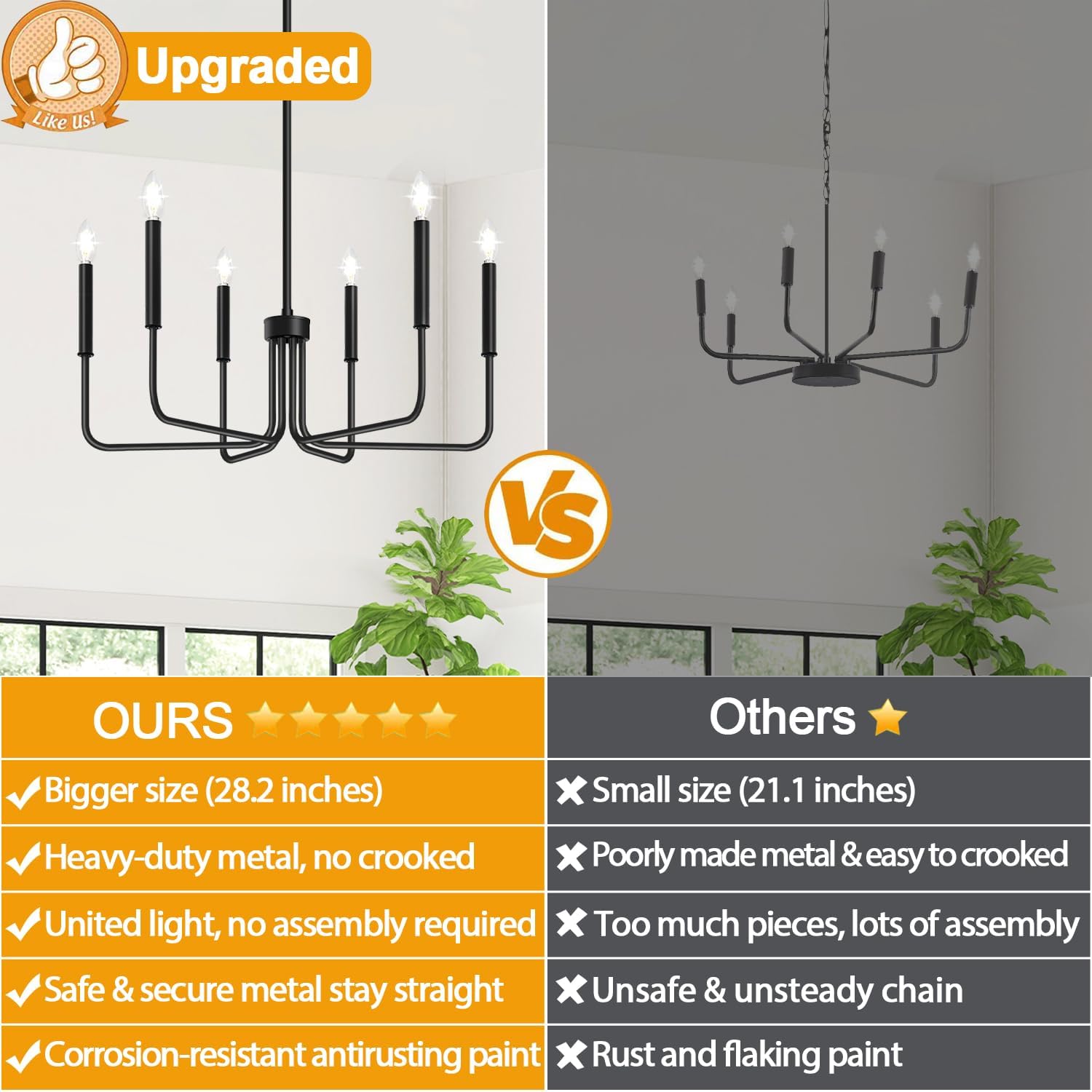
The black farmhouse 6-light chandelier (the one with folding arms that extend outward) earns specific praise because its arms fold out and lock into position with minimal installation steps. Buyers describe this as “you can tell someone thought about how this goes together.” That instinct tracks. A fixture designed for easy, reliable assembly typically means the manufacturer tested the assembly process — which means the tolerances on the mounting hardware are tighter, the canopy fits flush, and the chain length is pre-measured for typical ceiling heights.
Contrast that with fixtures where reviewers describe sorting through unlabeled hardware bags, mismatched screws, or arms that don’t seat properly into the center body. That’s not just an annoyance — it’s a signal that the product’s development process ended at “it photographs well.”
What to look for in listings:
- “Pre-assembled arms” or “folds open for installation” — positive signal
- “Includes detailed instructions” without any specifics — neutral to mildly negative
- Reviews mentioning “confusing instructions” or “missing hardware” — negative signal, and consistent enough to be predictive
Per This Old House’s chandelier installation coverage, the most common reason a DIY chandelier installation requires a second trip is a canopy that doesn’t sit flush against the ceiling — almost always a result of imprecise hardware tolerances, not installer error.
Sigaitwei buyers specifically call out an angled-ceiling toggle as a quality-of-thought detail that adds real value. An angled-ceiling adapter — the small pivot mechanism inside the canopy that lets the fixture hang plumb even when the ceiling slopes — costs pennies to manufacture and adds meaningful installation flexibility. That a manufacturer included it suggests they thought through real-world installation scenarios, which correlates with better overall product development.
The Brightness Problem: Candelabra Bases vs. Your Actual Dining Room
This is where the most purchases go wrong, and it’s entirely predictable from the spec sheet if you know what to look for.
Candle-style chandeliers — the ones with exposed “flame tip” bulbs on individual arms — almost universally use E12 candelabra base sockets (the small ones, roughly half the diameter of a standard bulb base). The problem: E12 bulbs max out at lower lumen outputs than standard E26 bulbs, and many of the decorative filament-style bulbs that look best in these fixtures produce 300–400 lumens each.
Do the math:
| Fixture | Sockets | Typical bulb (E12 filament) | Total lumens |
|---|---|---|---|
| 6-light candelabra chandelier | 6 | ~350 lm each | ~2,100 lm |
| 8-light candelabra chandelier | 8 | ~350 lm each | ~2,800 lm |
| 12-light Sputnik | 12 | ~450 lm each | ~5,400 lm |
Apartment Therapy’s dining room lighting coverage suggests that a dining table typically needs 3,000–4,000 lumens for comfortable task lighting at the table surface. A 6-light candelabra chandelier running decorative filament bulbs will fall short. The chandelier will look beautiful — and your dining room will feel dim.
The tradeoffs:
- Use higher-output E12 LED bulbs (some reach 500–600 lumens) — you recover some brightness but often lose the visual warmth of a thin filament
- Add a secondary light source (recessed cans, a buffet lamp, wall sconces) — the right answer architecturally, and what Architectural Digest’s room-by-room lighting guides consistently recommend for dining spaces
- Accept the ambient-only role and light the room for mood, not task — valid for spaces that don’t double as workspace
The Sputnik 12-light fixture has the opposite problem: reviewers consistently report it as uncomfortably bright without a dimmer. At 5,000+ lumens in a single fixture, it needs attenuation. Buyers who didn’t account for this find themselves either living with glare or paying an electrician to swap their switch for a dimmer after installation.
The rule: If a chandelier spec sheet lists E12 sockets and you need actual task or ambient lighting for the room, either plan for supplemental fixtures or verify the maximum wattage allows high-output LED bulbs. If a chandelier has 10 or more E26 or medium-base sockets, assume it needs a dimmer and plan accordingly.
Customer Service as a Purchase Signal
The Ganeed candelabra chandelier generates a notably specific review worth examining: a buyer describes receiving a fixture with shipping damage, contacting the seller, and receiving a free replacement in three days. The reviewer treats this as a major positive — and they should.
Here’s why this matters more than it might seem: fixtures in the $100–$300 range ship in boxes that traverse multiple warehouse handoffs. Bent arms, cracked glass shades, and dinged canopies are not rare exceptions. They’re a known hazard of the category. When a manufacturer resolves this quickly and without friction, it tells you two things:
- They have replacement parts in inventory, which means the fixture is manufactured at scale and won’t be discontinued six months after your purchase
- Their customer service is resourced to handle returns, which means they’ve priced in a certain return rate — which means they’re confident enough in their product to absorb it
A manufacturer that disputes shipping-damage claims or goes silent is, by contrast, signaling that returns are unexpected or unaffordable for them. Treat post-purchase service evidence in reviews the same way you treat finish quality: it’s a proxy for how seriously the product was developed.
Frequently Asked Questions
How do I know if a chandelier’s finish will look cheap in person based on product photos? Look for tonal variation in the finish — lighter highlights at edges, darker tones in recesses. A finish that looks identical across every surface is almost certainly a flat single-coat spray. Seeded glass, hammered textures, and finishes labeled “antique” or “aged” typically indicate layered or chemically developed processes that read as more substantial in person.
What does “pre-assembled” mean for a chandelier — do I still have to do anything before hanging? “Pre-assembled” usually means the arms, center body, or shade rings are factory-attached, so you’re not threading wire or seating arms from scratch. You’ll still connect the mounting bracket to your ceiling box, hang the fixture, and install bulbs. Think of pre-assembly as reducing installation from 45–60 minutes to 20–30 minutes — it doesn’t mean the fixture arrives ready to hang.
Will a 6-light candle-style chandelier provide enough light for a dining room, or do I need additional fixtures? Probably not on its own. Six E12 candelabra sockets running decorative filament bulbs typically produce around 2,000–2,100 lumens total. Most dining rooms benefit from 3,000–4,000 lumens at the table. Plan for a supplemental source — recessed cans on a separate circuit, a buffet lamp, or wall sconces — unless the space is small (under 100 square feet) or you’re lighting for mood only.
Why do some chandeliers need a dimmer and others don’t — how do I know before I buy? It depends on total lumen output and how the fixture is used. A 12-light Sputnik or similar high-socket-count fixture can exceed 5,000 lumens — bright enough to be uncomfortable for dining without attenuation. Any fixture you plan to use for both casual ambiance and brighter entertaining benefits from a dimmer. Check whether the bulbs included or recommended are listed as “dimmable” — non-dimmable LEDs will flicker or buzz on a dimmer circuit.
What should I do if my chandelier arrives with a bent or broken part — will the seller replace it? Document the damage with photos before unpacking fully, then contact the seller immediately through the platform’s messaging system. Most reputable manufacturers in the $100–$300 tier have replacement-part protocols for shipping damage. Per the Ganeed replacement-experience reviews, resolution within 3–5 business days is achievable with major sellers. If a seller disputes a clear shipping-damage claim, initiate a return through the platform — don’t attempt to bend or repair metal components, which can compromise structural integrity.
How do I adjust hang height if none of the included rods are the right length? Most chandeliers ship with multiple threaded rods that stack together — you use more rods for higher ceilings and fewer for lower ones. If you need a height between standard rod increments, a licensed electrician can cut a rod to length or source a custom-length rod from an electrical supply house. Apartment Therapy’s chandelier installation guide recommends 30–36 inches from the bottom of the fixture to the tabletop as the standard dining-room hang height — measure from your ceiling down to confirm which rod combination gets you there before you commit to installation.