Wall sconces — the light fixtures that mount flat against a wall and cast light upward, downward, or both — are one of the highest-impact upgrades you can make to a bedroom, hallway, or reading nook. The problem has always been the wiring. Installing a hardwired sconce means cutting into drywall, running wire through the wall cavity, and either hiring an electrician (typically $150–$300 per fixture in 2026, per This Old House’s electrical cost guidance) or having real confidence with a voltage tester and junction box. Most renters can’t do it at all. Even homeowners put it off for years.
That calculation has shifted. Battery-powered and plug-in wall sconces have matured to the point where “good enough” is no longer the right frame — some of them are genuinely good. But they solve different problems, carry different tradeoffs, and appeal to different buyers. This guide is for the person who’s already past “should I bother?” and into “which type is right for my specific situation, and what do I need to know before I pull the trigger?”
Battery vs. Plug-In: Two Different Animals
These two categories get lumped together constantly, which causes real buyer regret. Let’s separate them clearly.
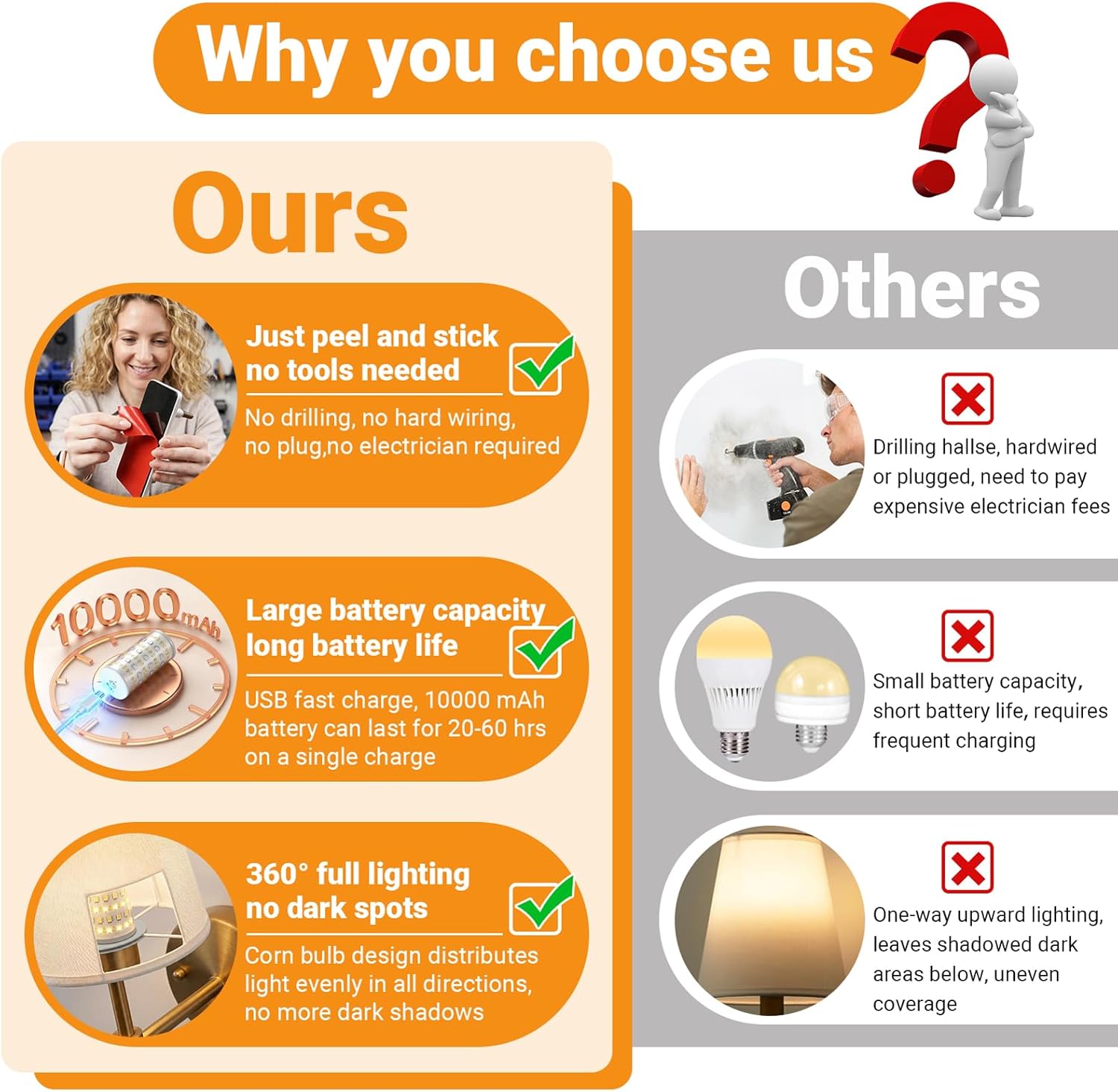
Battery-operated (rechargeable) sconces contain a built-in battery — typically a lithium-ion pack in the 3,000–10,000 mAh range. You mount them with adhesive pads or screws (no wire holes required), use them on battery power, and recharge via USB-C or a proprietary cable when depleted. They are completely wireless at the point of use. The tradeoff: they run out of power, and brightness is capped by what the battery can sustain safely.
Plug-in sconces draw power from a standard wall outlet through a visible (or concealed) cord. They can run at full brightness indefinitely, support dimmable bulbs, and accept LED retrofits. The tradeoff: there’s always a cord, and “concealed” is relative — it depends almost entirely on your wall color, cord management skills, and fixture design.
Both types skip the hardwired rough-in. Neither requires an electrical permit. But they’re solving for different rooms, different aesthetics, and different use-case priorities.
The Real Battery Life Math (And When It’s Enough)
Here’s the honest version of battery sconce math:
By the numbers:
- 10,000 mAh battery at 5V output ≈ 50 watt-hours of usable capacity
- A 3W LED lamp running 4 hours per evening draws ~12 Wh per night
- Theoretical runtime: ~4 nights at that draw rate before recharge is needed
- Real-world runtime (accounting for conversion losses): 2–3 nights of evening use per charge cycle
The Nekhung battery sconce — one of the more-reviewed rechargeable options on the market — ships with a dedicated recharge cord and an RGB remote control. Owners consistently describe the recharge routine as straightforward, and the RGB remote gets specific praise for being genuinely useful rather than gimmicky. But that math above reflects the fundamental ceiling: if you want ambient light every night for a week without thinking about it, a battery sconce requires either a very disciplined recharge habit or a unit with a larger battery than most currently offer.
As Apartment Therapy noted in their roundup “The Best Plug-In Sconces for Every Style and Budget,” battery-operated fixtures work best in lower-frequency scenarios: a guest bedroom, a reading nook used three nights a week, or a hallway that sees occasional late-night traffic. For a primary bedside sconce that’s on every single night, a plug-in option is more reliable in practice.
Plug-In Sconces: The Cord Problem and How Good Buyers Solve It
The most common objection to plug-in sconces is the cord. It’s a legitimate concern — a dangling white cord against a dark accent wall looks like an afterthought. But reviewers across multiple product categories consistently report that cord management is more solvable than it appears at purchase.
The KUZZULL matte black plug-in sconces draw repeated reviewer praise specifically for their adjustable cord length, which allows excess cord to be tucked behind furniture, routed inside cable raceways (paintable plastic channels that run flat against the wall), or gathered with a cord clip near the outlet. With a well-placed cord raceway painted to match the wall color, the installation reads as nearly hardwired from across the room.
Architectural Digest, in their editorial piece “The Best Wall Sconces to Buy Right Now,” notes that the “hardwired look” from a plug-in is achievable when three conditions line up: the outlet is within 18 inches of the fixture’s intended mounting height, the cord color matches the wall, and the cord path runs vertically rather than diagonally. When all three are true, most houseguests won’t notice.
The plug-in fabric sconce set from KUZZULL consistently earns buyer comments noting these fixtures “look so much better” than rechargeable alternatives — a real-world data point that the style gap between categories is still meaningful. If aesthetic finish is your top priority and you have a nearby outlet, plug-in wins the style comparison without much contest.
Linkind
$28.48
In stock on Amazon
Check price on AmazonDimming, Brightness, and Bulb Compatibility
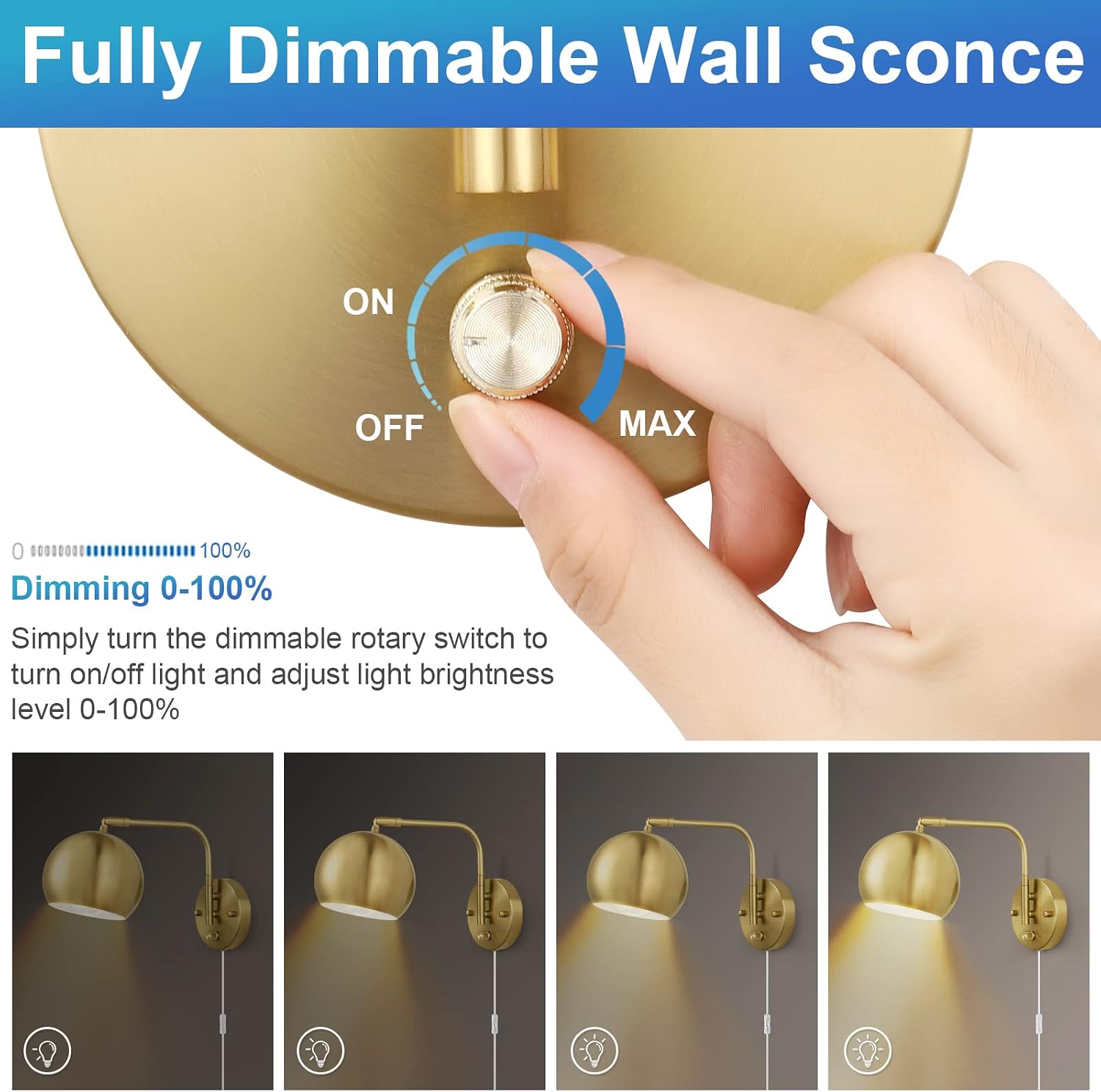
This is where plug-in sconces hold another structural advantage. The VATONI brushed brass swing-arm sconces arrive with bulbs included and feature a built-in dimmer knob on the cord — a genuinely useful detail that eliminates the need for a smart bulb or a separate dimmer switch. Owners call out the dimmer knob as a “why doesn’t every sconce have this?” feature, particularly for bedside use where you want a gradual wind-down from reading brightness to low ambiance.
For buyers who need real reading light — not just ambiance — the calculus is straightforward. Per Energy.gov’s resource “LED Lighting,” effective task reading requires 450–800 lumens directed at the page. Most battery sconces top out around 200–300 lumens in their brightest mode, which is mood lighting, not reading light. A plug-in sconce with a standard E26 socket (the common screw-base found in most US fixtures) can accept any LED bulb up to the rated wattage, including high-CRI reading-optimized bulbs in the 800-lumen range.
If reading is a primary use case, look for a plug-in sconce with a standard E26 socket, a swing-arm for directional control, and a built-in dimmer. That combination is available at multiple price tiers and will outperform any current battery alternative for genuine task lighting.
VATONI
$59.99
In stock on Amazon
Check price on AmazonThe Govee RGBIC Situation: Read This Before You Buy
The Govee RGBIC smart wall sconces have developed a specific buyer surprise that doesn’t surface clearly in product listings: the two units in the set are wired together internally and cannot be split for use in separate rooms or separate locations. They function as a connected pair sharing a single power source.
This isn’t a defect — it’s a design choice that makes sense for their intended use (flanking a TV, creating a symmetrical accent wall effect). But buyers who purchase expecting two independent smart sconces they can place in different areas of a room, or in separate rooms entirely, consistently report discovering the limitation only after unboxing.
The Govee RGBIC units are genuinely impressive as an RGBIC (Red, Green, Blue, plus an independently controlled chip that allows gradient color effects) accent lighting system. They’re a poor choice if you need placement flexibility.
Smart-home context matters here too. Houzz’s editorial “Wall Sconce Placement & Sizing Guide” recommends a minimum 6-foot center-to-center spacing for paired bedside sconces. The Govee units’ tethered cord length sets a hard maximum on how far apart they can be positioned, so measuring your intended wall space before purchasing is not optional — it’s necessary.
Dimmable
$66.99
In stock on Amazon
Check price on AmazonThe Decision Framework: If X, Then Y
After working through the real tradeoffs, the decision tree looks like this:
If you’re in a rental with no outlet near the intended sconce location → Battery/rechargeable is your only realistic option. Accept the 2–3 night recharge rhythm and choose a unit with a USB-C port for flexibility.
If you have an outlet within 24 inches of the mounting location and aesthetics matter → Plug-in sconce, full stop. The style gap between plug-in and battery is real, cord management is more solvable than it looks, and you’ll never think about battery life again.
If bedside reading light is the primary job → Plug-in swing-arm with a standard E26 socket and a built-in dimmer. The VATONI brushed brass option is a strong entry point for this use case. Battery units simply cannot hit the lumen output task reading requires, as confirmed by Energy.gov’s “LED Lighting” guidance on lumen thresholds for task illumination.
If you want RGB smart color effects for accent or media-room use → Govee RGBIC is legitimately good at its intended job. Confirm the cord length works for your intended pair placement before purchasing, and plan for them as a permanently paired unit.
If the look of hardwired is non-negotiable but wiring isn’t an option → Plug-in with a paintable cord raceway. Choose a sconce with an adjustable cord, run the raceway vertically to the nearest outlet, and paint it to match the wall within 48 hours of installation.
Frequently Asked Questions
How long does a 10,000 mAh battery wall sconce last between charges with normal evening use? Working from the battery math: a 3W LED running 3–4 hours per evening draws roughly 10–12 watt-hours nightly. A 10,000 mAh battery at 5V holds approximately 50 watt-hours, but real-world conversion losses reduce usable capacity to roughly 35–40 Wh. That puts practical runtime at 3–4 nights of moderate evening use before recharge. Owners of the Nekhung sconce report this aligns closely with their experience, with the recharge itself taking 2–3 hours via the included cord.
Can plug-in wall sconces look truly hardwired, or is the cord always visible? They can read as near-hardwired when conditions align: outlet close to the fixture, vertical cord path, paintable raceway matching the wall. Reviewers of plug-in fabric sconces consistently note the effect is convincingly clean in photos and in person. It’s never invisible under close inspection, but it is well within acceptable for most real-world installations. Architectural Digest’s sconce coverage describes this as the “hardwired look” achievable without any rough-in work.
Are the Govee RGBIC wall sconces truly two independent lights, or do they have to be used as a connected pair? They must be used as a connected pair. The two units share a single power connection and cannot be separated for independent use in different locations. This is a deliberate design feature for their intended symmetrical placement use case — but it’s a meaningful limitation if you expected two independently deployable smart sconces.
What is the brightest plug-in sconce option for someone who needs actual reading light, not just ambiance? Look for a plug-in swing-arm sconce with a standard E26 socket rated for bulbs up to 60W equivalent. That socket will accept LED reading bulbs in the 800-lumen range — well above what any current battery sconce delivers. Per Energy.gov’s “LED Lighting” resource, 450–800 lumens is the recommended range for task reading. A built-in dimmer, like the VATONI’s cord-mounted knob, lets you scale from full reading brightness to sleep-friendly ambiance without a separate smart bulb.
Can battery-operated sconces be used outdoors or in bathrooms? Most battery sconces carry no IP (Ingress Protection) rating, meaning they are not rated for moisture or weather exposure. Using an unrated unit in a bathroom near a shower or sink, or outdoors where they’d be exposed to humidity or rain, risks both fixture failure and — since lithium-ion batteries are involved — a more serious safety issue. Unless a specific unit explicitly carries an IP44 or higher rating (sealed against splashing water), treat battery sconces as indoor, dry-location fixtures only.