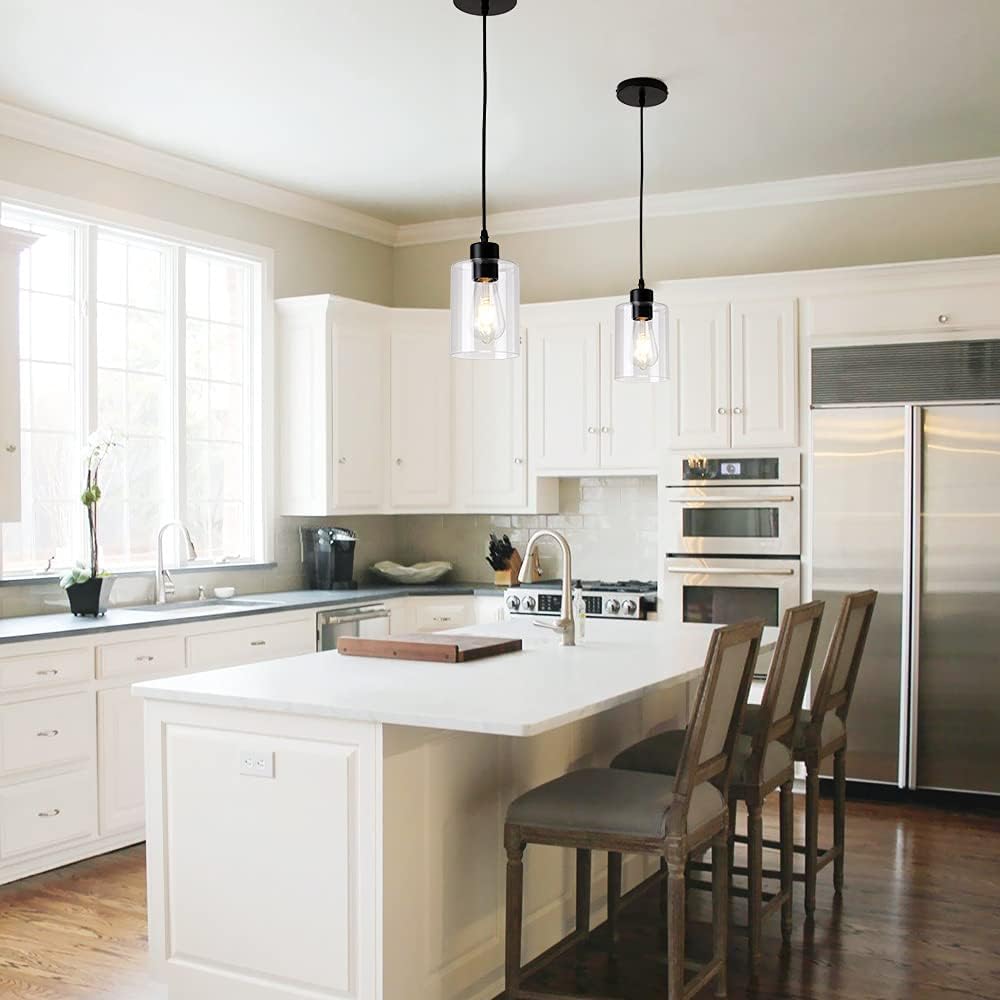
Art Glass, Seeded Glass, and Handblown Pendants: How to Choose a Statement Pendant That Holds Up to Scrutiny
You’ve landed on a glass pendant — maybe a cluster of three over the kitchen island, maybe a single dramatic bell above a dining table. The product photos look expensive, the reviews say “looks way more expensive than it is,” and you’re 80% sure you’re ready to buy. Then the second-guessing kicks in: Is the glass actually handblown, or is that marketing language? Will three of these fit my island without crowding it? What happens when I cut the cord too short?
These are exactly the right questions. A glass pendant light — meaning a hanging fixture where the shade is made of glass rather than fabric, metal, or resin — is one of the most scrutinized objects in a room. It hangs at eye level, it interacts with your bulb’s light quality, and it reflects finishes on adjacent hardware. Getting it right takes about fifteen minutes of planning. Getting it wrong means a return shipment of bubble-wrapped glass, which nobody wants. This guide gives you that planning framework, drawn from the patterns buyers report after living with these fixtures.
| EDITOR'S PICK[CASAMOTION Pendant Lights Kitch…](https://www.amazon.com/dp/B09ZV21LXD?tag=greenflower20-20) | Mid-tier[INK+IVY Auburn Pendant Lighting…](https://www.amazon.com/dp/B0D36BDV5N?tag=greenflower20-20) | Budget pickModern Black Farmhouse Clear Gl… | |
|---|---|---|---|
| Shade Shape | Organic Globe | Bell Shaped | Cylinder |
| Shade Dia. | 8" | 9" | 4.75" |
| Glass Type | Clear Glass | Hand-blown Glass | Clear Glass |
| Adjustable | ✓ | — | — |
| Pack Qty | 2 | 1 | 2 |
| Material | Brass | Gold/Cl | Black |
| Price | $139.50 | $85.65 | $41.70 |
| See on Amazon → | See on Amazon → | See on Amazon → |
What Actually Makes a Glass Pendant Look (and Feel) Expensive
Reviewers across the glass pendant market keep gravitating toward the same phrase: “looks more expensive than it is.” That’s a meaningful data point, but it’s worth unpacking which construction details trigger that reaction — because they’re the same details you should be evaluating on spec sheets before you buy.
Hidden internal wire routing is the most cited quality signal. When the electrical cord runs through a metal canopy — the ceiling-mounted hardware cap that covers the junction box — instead of dangling visibly above the glass, the fixture reads as intentional and finished. Buyers of marble-and-glass pendants specifically call out internal wire routing as the detail that tips a fixture from “looks like a warehouse site” to “looks like a boutique lighting shop.” When you’re comparing options, look for listings that describe wiring “concealed inside the canopy” or “cord feeds through metal hardware.”
The physical weight and quality feel of the glass is the second signal buyers name. Heavier glass — typically mouth-blown or hand-formed — has a density you can hear when you handle it. Thin-cast glass rings hollow. You can’t evaluate this from a photo, which is why verified buyer language matters: reviewers describing glass as “substantial,” “heavy,” or “thick-walled” are describing real construction, not just good packaging.
Generous, accurately described cord length might sound like a minor convenience, but it matters because cord length is the one spec you cannot modify upward — you can only cut down, never add back. A listing that gives you 60–72 inches of adjustable cord before the canopy is giving you margin for error. A listing that ships 36 inches of fixed cord is betting on your ceiling height matching theirs.
By the numbers:
- Ideal pendant hang height over a kitchen island: 30–36 inches above the countertop surface, per Apartment Therapy’s editorial guide on pendant light height
- Minimum clearance above a dining table: 30 inches; the standard recommendation is 32–34 inches
- Typical adjustable cord range for quality pendants: 48–72 inches from canopy to shade
- Standard junction box to countertop drop in a home with 9-foot ceilings: approximately 60 inches
The Cord-Cutting Decision: The Permanent Choice Most Buyers Make Wrong
Here’s the mistake that shows up repeatedly in post-purchase reviews: “I wish I’d hung them lower before cutting the cord.” That sentence is doing a lot of work.
Cutting the electrical cord on a pendant is irreversible. Once it’s cut, the fixture hangs at that height forever — or until you source a replacement cord set, which is an annoying and often imprecise fix. The right sequence is:
- Mount the canopy and hang the pendant at maximum cord length.
- Live with it for a day. Eat at the island. Sit at the table. Notice whether it blocks sightlines across the room.
- Mark your target height with tape on the cord.
- Cut — and leave an extra two inches of buffer inside the canopy, because you can always tuck slack, but you can’t un-cut.
Architectural Digest, in its editorial guide “How to Choose the Right Pendant Light for Every Room,” makes this practical point clearly: when in doubt, hang lower rather than higher — a pendant that’s too high loses its visual impact and stops functioning as task lighting. Over an island, pendants that hang too high read as ceiling fixtures. At 30–36 inches above the counter, they define the space and deliver usable light.
This sequencing is especially critical when ordering multiple pendants for an island run. Cut one cord, evaluate the height in real space, then cut the others to match. Do not cut all three simultaneously straight from the box.
Glass Type Decision Framework: Clear, Seeded, or Art Glass
These three categories behave differently enough that they deserve to be treated as distinct choices, not just aesthetic variants.
Clear glass is transparent, with minimal distortion and maximum visibility of the bulb. The black-and-brass clear cylinder pendant style makes this tradeoff explicit: the bulb is the design element. A standard frosted A19 LED inside a clear glass pendant creates a flat, utilitarian look. A warm-white Edison-style filament bulb — technically an ST19 or T10 tubular shape — reads as deliberate and atmospheric. Color temperature matters: 2200K–2700K reads warm and incandescent; 3000K is cleaner and slightly cooler. If you’re specifying clear glass pendants, budget for decorative bulbs. It is not optional.
Seeded glass contains small intentional air bubbles trapped in the material during forming. Those bubbles scatter and diffuse light as it passes through, softening harsh spots and creating a texture that reads as handcrafted even when it isn’t. The practical effect: seeded glass is more forgiving of bulb shape and placement than clear glass, and it masks hot spots from exposed filaments. It’s a good choice for kitchen islands where you want the pendant to glow rather than spotlight. Houzz’s editorial coverage of kitchen pendant lighting notes that seeded glass remains one of the consistently popular finishes for transitional and farmhouse kitchen styles precisely because it works across finish families — brass, black, nickel — without reading as trend-dependent.
Art glass is the broadest category — it includes hand-blown forms, rippled or ribbed surfaces, milk glass, smoked or amber glass, and textured blown shapes like hand-formed bell pendants. The key construction distinction for art glass is whether it’s genuinely hand-formed — meaning each piece shows slight variation in shape and thickness — versus molded glass marketed with “artisan” language. Real hand-blown glass at the $80–$200 price point typically shows minor irregularities: slight asymmetry, small surface variations, subtle thickness differences between pieces in a set. These are authenticity markers, not defects. If perfect geometric symmetry is your priority, molded glass or a metal shade is the right choice.
Sizing and Spacing: The Math Before You Commit
The most practical complaint in reviews of large hand-blown bell pendants is this: buyers ordered the wrong size because they didn’t translate listed dimensions into real-world scale. This is a solvable problem with one step: cut a paper template.
Before you buy, take the listed diameter of the shade — say, 8 inches or 12 inches — and cut a circle of that diameter from kraft paper or newspaper. Tape it to a cabinet or hold it at pendant height over your island. Look at it from standing height and from sitting height. Does it feel proportional? Does a row of three feel crowded or sparse?
The general spacing rules, consistent across editorial guidance from Apartment Therapy, Houzz, and Architectural Digest:
- Number of pendants over an island: One pendant per 2 feet of island length is a reliable starting point. A 6-foot island typically takes 2–3 pendants; a 4-foot island typically takes 1–2.
- Spacing between pendants: 24–30 inches on center (center of one pendant to center of the next) for most shades 6–10 inches in diameter. Larger shades — 12 inches and up — need 30–36 inches of center-to-center spacing.
- Distance from island edges: Leave at least 6–12 inches from the first pendant center to each end of the island, so the pendants read as a deliberate cluster rather than running off the edge.
If you’re ordering pendants with adjustable cords and buying multiple units, purchase one first if the retailer allows returns. Evaluate the scale in person before committing to the full set.
Finish Mixing: Black and Brass Don’t Have to Match Exactly
One of the most common questions across glass pendant design discussions is whether mixed metal finishes — particularly matte black fixtures with brass hardware accents — read as intentional or as a mistake. The short answer: mixed finishes work when there’s a logic to the pairing, and fail when it looks like a budget decision.
Black-and-brass pendants have become a reliable transitional finish because the combination reads as deliberate contrast rather than mismatch. The rule that This Old House editorial coverage and Architectural Digest’s finish guides consistently apply: pick one dominant finish — usually the shade or the largest surface area — and let the second finish appear as an accent, such as hardware, a socket ring, or a canopy detail. A matte black glass pendant with a brass canopy is a finish combination, not a mistake — as long as the brass accent echoes somewhere else in the kitchen, whether in a faucet, cabinet hardware, or drawer pulls.
You don’t need an exact match. You need visual repetition. If your kitchen hardware is unlacquered brass and your pendants are antique brass, the slight variation reads as layered rather than mismatched. If your hardware is polished chrome and your pendants are warm brass, you have a mismatch that draws attention for the wrong reason.
Frequently Asked Questions
How do I figure out the right hang height for a pendant over a kitchen island before I cut the cord? Hang the pendant at full cord length, then use a painter’s tape flag at the 30-inch and 36-inch marks above your countertop surface. Stand back and evaluate from normal kitchen distance — not from directly underneath. The 30–36 inch range, consistent with Apartment Therapy’s editorial guidance on pendant light height, covers most island configurations, but ceiling height and shade diameter can push you toward the lower or higher end. When uncertain, start at 34 inches and adjust before cutting.
Does a clear glass pendant work with regular LED bulbs, or does it require a decorative filament bulb? It works with any bulb that fits the socket, but a standard frosted LED will look utilitarian inside clear glass — the frosted dome becomes the only visible element, and it reads as a bare bulb rather than a design choice. Decorative filament bulbs — ST19, T10, or G25 globe shapes — in warm white (2200K–2700K) are the design-correct pairing for clear glass pendants because the bulb’s form and warm glow become visible design elements.
What is seeded glass, and how does it affect light quality compared to clear glass? Seeded glass contains small air bubbles intentionally introduced during the forming process. Those bubbles scatter light as it passes through, creating a soft, diffused glow rather than a direct beam. Compared to clear glass, seeded glass hides hot spots and bulb shapes, produces a warmer and more even ambient light, and works with a wider range of bulb types. The tradeoff is less task-lighting punch — if you need focused countertop illumination, a clear glass or open-shade pendant delivers more directed light.
Can I mix black and brass finishes on pendant lights, or do they need to match exactly? They don’t need to match exactly — intentional contrast is a legitimate design approach. The principle is visual repetition: if your pendants have black shades with brass hardware, echo that brass somewhere else in the room. The finish that should align most closely is the canopy-to-ceiling-medallion pairing, since those two elements sit in close proximity and variation there reads as an oversight rather than a choice.
How many pendant lights do I need over a kitchen island, and how far apart should they be? A standard starting point: one pendant per 2 feet of island length, spaced 24–30 inches on center for shades up to 10 inches in diameter. A 6-foot island typically takes 2–3 pendants. Leave 6–12 inches from the pendant center to each end of the island. If your shades are 12 inches or larger, increase center-to-center spacing to 30–36 inches to avoid a crowded look.
What does “hand-blown glass” actually mean for a pendant at this price point — is it really handmade? At the $80–$200 price tier, “hand-blown” generally means the glass was formed by a glassblower using a blowpipe and molds — a real hand-forming process, but typically in a production setting rather than a studio art context. The honest signal of genuine hand-blown glass is slight variation: minor asymmetry, small surface irregularities, subtle thickness differences between pieces in a set. These are authenticity markers, not defects. If a listing at this price point shows product photos where every pendant looks machine-perfect with zero variation, the “hand-blown” claim is likely marketing language for molded glass.